
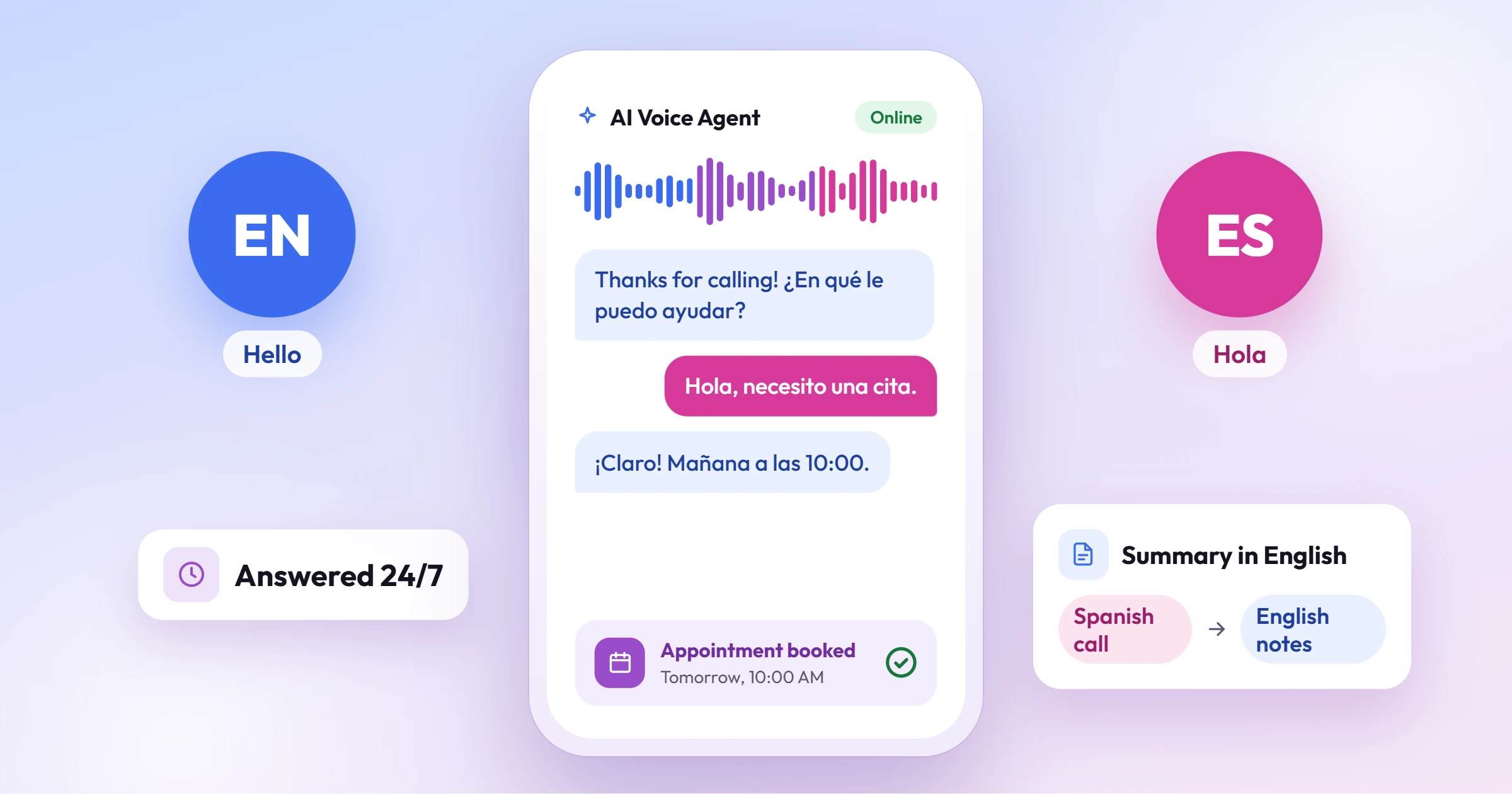
A Spanish-speaking customer calls your business about a leaking water heater. They hear an English greeting, try to explain the problem, and get stuck on the words. They hang up and call the next company on the list.
You never see that call as a lost job. It shows up as a short call or a missed call, if it shows up at all.
A bilingual answering service fixes this by answering every call in English or Spanish. This guide explains how these services work, what they cost, and how to set one up. It also covers how to choose between human receptionists, AI agents, or a mix of both.
Key Takeaways
- A bilingual answering service answers calls in English and Spanish using live receptionists, AI, or both. It works on your existing number, with no menu for callers to press.
- It's built for law firms, healthcare practices, and home service businesses that get Spanish-speaking callers and can't staff bilingual coverage around the clock.
- Spanish callers who hit an English-only line often hang up and call a competitor. Bilingual answering captures those calls before they're lost.
- Live receptionists handle complex and emotional calls best, AI covers high volume and after-hours calls at a lower cost, and hybrid setups combine both.
What Is a Bilingual Answering Service?
A bilingual answering service answers your business calls in two languages, most often English and Spanish, using your business name. Calls are handled by bilingual human receptionists, an AI voice agent, or both. The service answers questions, books appointments, takes messages, and sends you a summary in the language you read.
A Spanish answering service usually handles Spanish calls only. An interpreter line is different again: it interprets a live conversation between you and the caller.
How a Bilingual Call Works, Step by Step
Every bilingual call goes through four stages: the greeting, language selection, the conversation, and the handoff to you. The biggest difference between services is how they handle language selection.
The three ways calls get routed
Menus are the oldest option and the most likely to lose callers. Greetings in both languages and automatic detection put the caller in a conversation right away.
What happens when callers switch languages mid-call
Many bilingual callers mix English and Spanish in the same sentence. Linguists call this code-switching, and it is common in U.S. Spanish.
A caller might say, "Necesito una cita para el oil change." A skilled human agent follows along without comment. A good AI agent keeps going in the caller's main language without restarting the call.
Weaker systems ask the caller to choose a language again or lock into the first language they hear. Test this before you sign up (see the testing checklist below).
A sample bilingual call
Here is how a short call to a dental office sounds when it goes well:
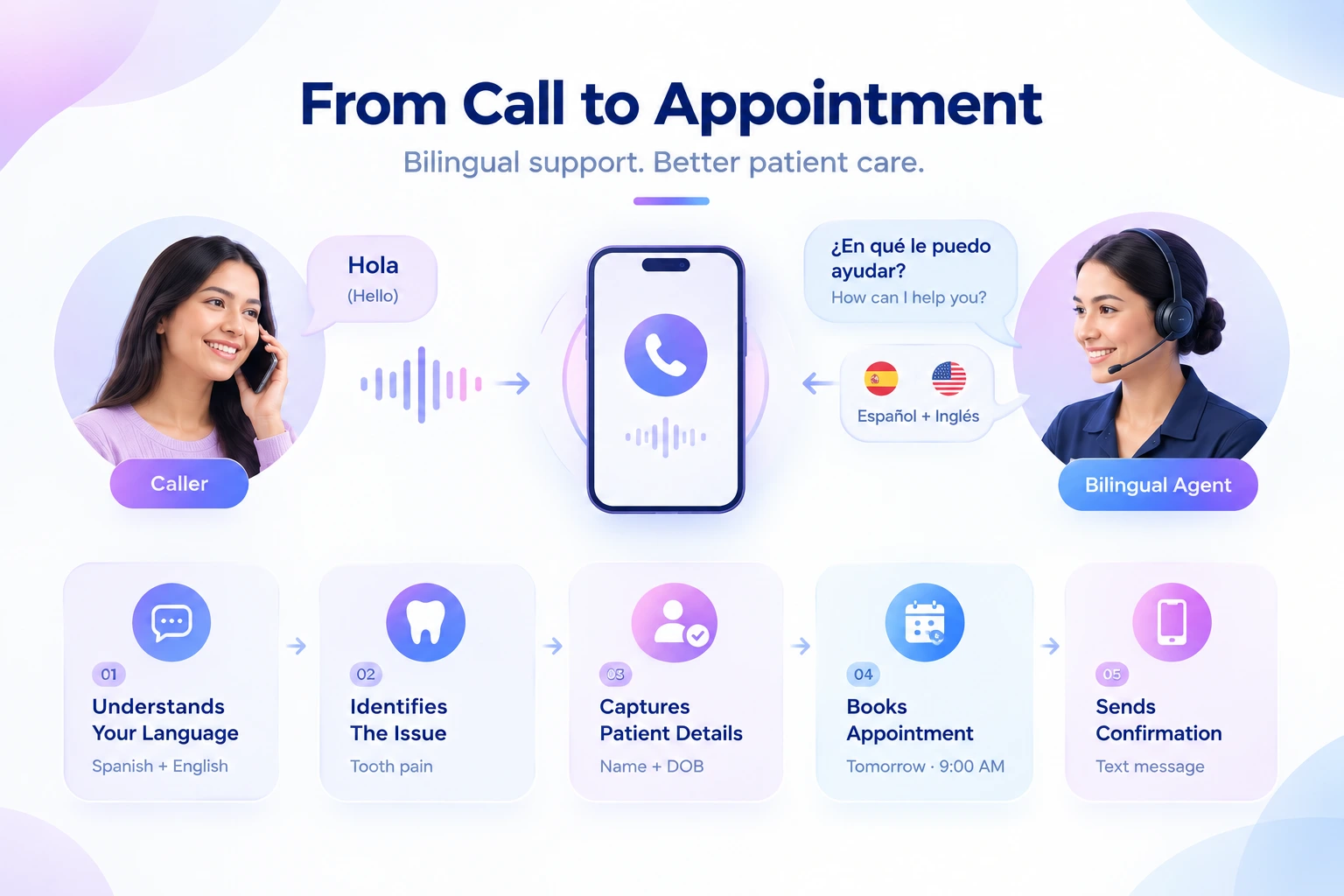
Agent: Gracias por llamar a Clínica Dental Sonrisa. Thank you for calling. ¿En qué le puedo ayudar?
Caller: Hola, me duele mucho una muela desde ayer.
Agent: Lo siento mucho. ¿Me puede dar su nombre completo y su fecha de nacimiento?
Caller: María Elena Torres Gómez, 14 de marzo de 1981.
Agent: Gracias. Tenemos una cita mañana a las 9:00 a. m. ¿Le funciona?
Caller: Sí, perfecto.
Agent: Listo. Le enviaremos un mensaje de texto con la confirmación.
The office manager, who doesn't speak Spanish, then receives this summary:
- Caller: María Elena Torres Gómez (DOB 03/14/1981)
- Language: Spanish
- Reason for call: Severe toothache since yesterday
- Action taken: Booked tomorrow at 9:00 AM; confirmation text sent in Spanish
- Follow-up needed: None
How you get the message if you don't speak Spanish
Most services translate the call summary into English and keep the original Spanish transcript on file. The caller gets confirmations and reminders in Spanish, while you get notes you can act on.
Ask each vendor whether summaries are translated by a person or by software. Machine translation is fast, but it can garble names, medication terms, and addresses.
Why English-Spanish Call Support Matters
Spanish is the most common non-English language spoken in U.S. homes, and many callers handle business more comfortably in Spanish. That preference is strongest on stressful calls, which are often the calls worth the most to your business.
How many of your callers prefer Spanish
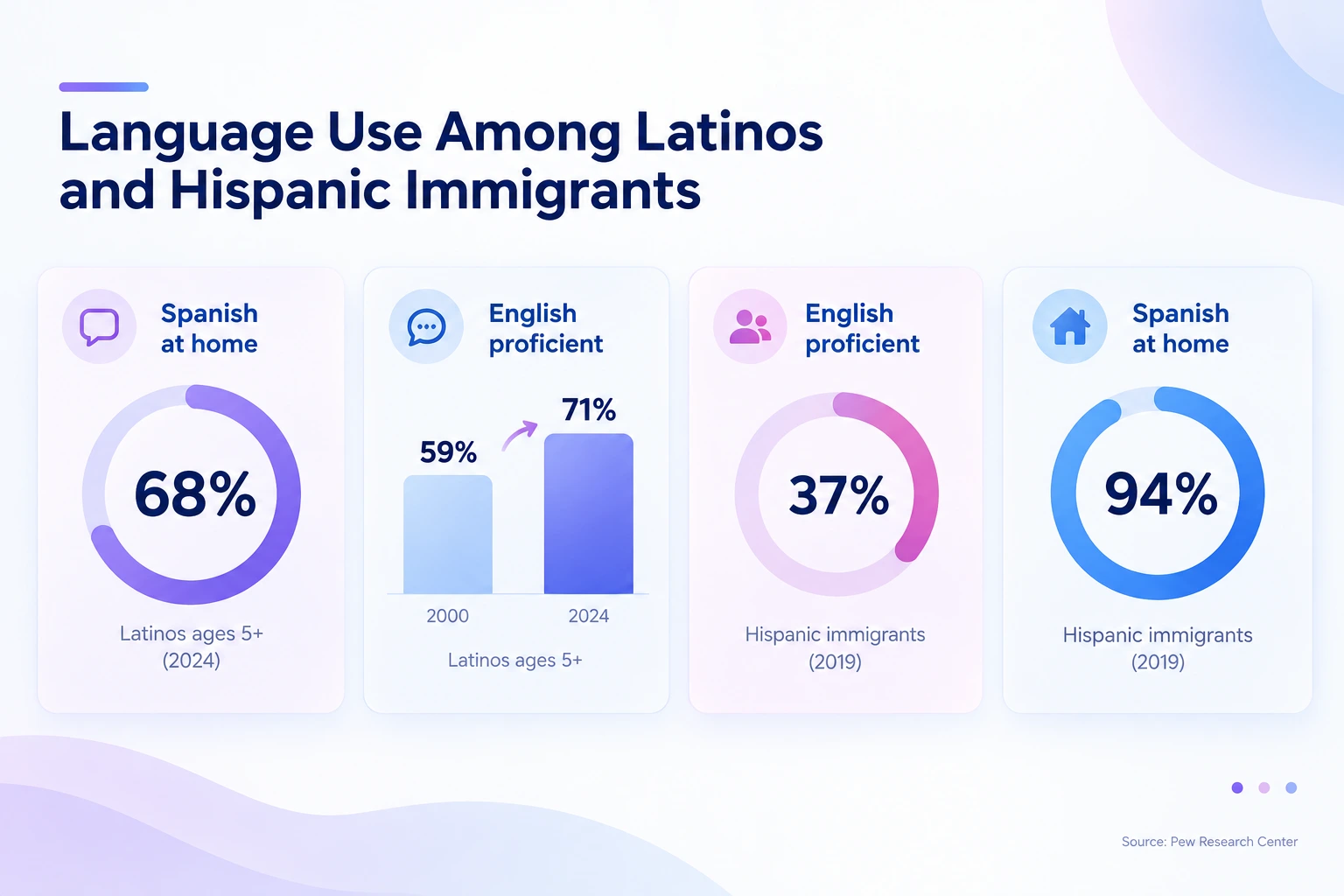
Most Latino callers speak English, but a large share still use Spanish at home. Here is what the latest data shows:
- According to Pew Research Center's Key facts about U.S. Latinos (2025), 68% of Latinos ages 5 and older spoke Spanish at home in 2024.
- The same report found 71% of Latinos ages 5 and older spoke English proficiently in 2024, up from 59% in 2000.
- Pew Research Center's A brief statistical portrait of U.S. Hispanics (2022) found only 37% of Hispanic immigrants spoke English proficiently in 2019. About 94% spoke Spanish at home.
Many callers can get by in English, but they would rather not. Immigrant callers are the group most likely to need Spanish to finish the call at all.
Why preference matters most on high-stakes calls
Someone who orders lunch in English may still struggle to describe chest pain, a car accident, or a gas smell. Second-language skills tend to break down when details matter and the caller is stressed.
These are the calls where language gaps cause the most trouble:
- Medical and dental: symptoms, medication names, insurance details
- Legal intake: dates, injuries, what was signed, immigration questions
- Emergency repairs: what broke, where the leak is, whether anyone is at risk
- Billing and insurance: amounts, policy numbers, payment plans
- Contact details: spelling names with two surnames, street names, unit numbers
A mistake in any of these leads to a wasted truck roll, a wrong appointment, or a lost case.
What happens when a call hits a language barrier
Most callers who can't communicate simply hang up and try someone else. You rarely find out why.
Other common outcomes include:
- The caller leaves no voicemail, or leaves one in Spanish that nobody on staff can understand.
- A bilingual employee gets pulled off their own work to handle the call.
- A caller's child or relative interprets, which can lead to errors and privacy problems.
- The caller leaves a frustrated review in Spanish on Google.
Human Receptionist vs AI vs Hybrid Bilingual Answering
Live receptionists handle emotional and unusual calls best, while AI handles high volume and after-hours calls at a lower cost. Hybrid setups use AI for routine calls and hand harder ones to a person.
Live bilingual receptionists
Live bilingual receptionists are trained agents, usually at a call center, who answer calls in your business name. They follow a script you approve and can switch between English and Spanish as needed.
Typical features:
- Custom greetings and scripts in both languages
- Message taking and appointment booking
- Intake forms for new clients or patients
- Warm transfers to you or your staff
AI bilingual answering services
An AI bilingual answering service uses a voice agent that speaks and understands both languages. It answers every call immediately, including several calls at the same time.
Typical features:
- Automatic language detection with no menu
- Answers drawn from a knowledge base you write
- Direct booking into your calendar
- Confirmation texts in the caller's language
- English call summaries and full transcripts
- Spam and robocall filtering
Hybrid: AI first, humans for escalations
In a hybrid setup, AI answers every call and transfers to a live bilingual receptionist when the call needs a person. You pay AI rates for routine calls and human rates only for the hard ones.
Common reasons to escalate a call:
- The caller asks for a person.
- The caller mentions an emergency, injury, or safety risk.
- The caller sounds upset or confused.
- The question isn't covered in the knowledge base.
- The caller is a high-value lead, like a new legal case or a large job.
The weak point is the handoff. Ask whether the human team has Spanish speakers on the same hours the AI escalates. Also confirm the AI passes notes along so the caller doesn't have to repeat everything.
Side-by-side comparison
Key Features to Look For Bilingual Answering Services
The most important feature is real Spanish coverage on every hour you need it. These seven features separate a dependable service from one that loses callers.
True 24/7 Spanish coverage
Many services advertise bilingual support but staff Spanish speakers only during the day. Ask whether Spanish speakers work every shift, including nights, weekends, and holidays. AI services usually cover all hours by default.
No-menu routing and language switching
Callers should be able to speak Spanish right away without pressing a key. Look for a greeting in both languages or automatic language detection. Also ask what happens when a caller switches between English and Spanish mid-call.
Natural, respectful Spanish
Good Spanish on a business line sounds polite, clear, and neutral. The formal "usted" is the safer default, and agents should understand vocabulary from Mexico, the Caribbean, and Central and South America. Ask which accents the vendor has tested, and have a native speaker call to judge.
Accurate names, numbers, and addresses
Double surnames, accent marks, and Spanish street names are easy to get wrong. Ask how agents or the AI confirm spelling in Spanish. One wrong digit in a phone number turns a booked job into a lost lead.
Bilingual booking and confirmation texts
The service should book directly into your calendar while the caller is on the line. Confirmations and reminders should go out in the caller's language. An English-only text after a Spanish call confuses customers and can lead to missed appointments.
English summaries and original transcripts
You need call notes you can read and act on, even if you don't speak Spanish. Ask whether summaries are translated by a person or by software. Keep access to the original Spanish transcript in case something looks wrong.
Integrations and warm transfers
Bookings and leads should land in the calendar, CRM, or practice management software you already use. For urgent calls, ask whether the service can transfer to your phone with a short English briefing first. You'll know who is calling and why before you pick up.
Small Details That Make Spanish Calls Go Well
Fluent Spanish is only part of good service. The details below cause the most errors and awkward moments on Spanish calls, and a good service handles all of them.
Two surnames
Many Spanish speakers use two surnames: the father's first, then the mother's. María Elena Torres Gómez usually goes by "Señora Torres," not "Señora Gómez."
Your service should capture both surnames and file the record under the first one. Otherwise, returning callers end up with duplicate records in your CRM.
Formality and titles
Use "usted" and titles like "señor" and "señora" unless the caller signals otherwise. Some older callers may also be addressed as "don" or "doña" as a mark of respect.
Starting too casual can come across as rude. It is easier to relax the tone later than to recover from a bad first impression.
Dates, times, and numbers
Many Spanish speakers write dates as day, month, year. A date written as 03/04 could mean March 4 or April 3, so agents should confirm the month by name.
Watch for "mañana," which means both "tomorrow" and "morning." Phone numbers are often read in pairs, like "cincuenta y cinco, veintitrés," so agents should read every number back.
Addresses
Callers may give the street name before the house number, the way addresses work in Latin America. Agents should confirm the full address in the U.S. format your technicians and mail use.
Bilingual Answering Service Costs and Pricing
Bilingual answering ranges from about $0.11 per minute on some AI services to several hundred dollars a month for live receptionist plans with small minute allowances. What you pay depends mostly on the pricing model and your call volume.
The four pricing models
- Per minute: You pay a monthly fee for a set number of minutes, then a higher overage rate for every minute past that. Watch for rounding, per-call minimums, and steep overage rates.
- Per call: You pay for a set number of calls each month, then a fee for each extra call. A 20-second wrong number costs the same as a 10-minute intake, so this model suits businesses with longer calls.
- Flat monthly: You pay one fixed price for unlimited calls or a high call cap. Check for fair-use limits and features locked to higher tiers.
- Pay as you go: You pay a per-minute rate with no monthly base fee. It's cheapest at low volume, but costs climb quickly as your calls grow.
Prices above come from third-party comparison sites and vendor pages checked in 2026. Confirm current rates with each vendor before you buy.
Billing details that inflate your bill
The advertised plan price is rarely what you pay. Check the contract for these:
- Rounding: Some vendors round every call up to the next full minute.
- Call minimums: Ruby, for example, applies a 30-second minimum to each call.
- Ring time and spam: Some reviewers report paying for ring time and spam calls on per-minute plans.
- Overage rates: Rates beyond your plan often run well above the plan's effective per-minute price.
- After-hours or holiday premiums: Some live services charge more outside business hours.
- Setup and integration fees: Ask whether connecting your calendar or CRM costs extra.
- Contract terms: Check for annual commitments and price increase clauses.
A worked example: 200 calls a month
This example assumes 200 calls a month averaging 2.5 minutes each, or 500 minutes total. The rates are typical ranges, not quotes from any single vendor.
The gap widens as volume grows. At 500 calls a month, live per-minute plans can cost several times more than flat AI plans.
What a bilingual in-house receptionist costs
Hiring your own staff costs far more if you want round-the-clock coverage. According to the BLS Occupational Outlook Handbook: Receptionists, the median hourly wage for receptionists was $17.90 in May 2024.
That works out to about $37,200 a year for one full-time employee, before payroll taxes and benefits. Covering 168 hours a week takes about 4.2 full-time employees, or roughly $156,000 a year in wages alone.
Bilingual hires may expect a pay premium. You also need coverage for sick days and vacations, and each person can still take only one call at a time.
How to Set Up a Bilingual Answering Service
Most businesses can launch bilingual answering in a few days to two weeks. These six steps cover everything from checking demand to tracking results.
- Pull your call data.
Review 30 to 60 days of call logs. Count callers who asked for Spanish, hung up quickly, or left Spanish voicemails, and note the hours they called. Ask your front desk staff what they hear, too.
- Decide coverage and escalation rules.
Choose which hours need Spanish coverage and which calls must reach a person. Write down what counts as an emergency and who gets those calls.
- Build your knowledge base and scripts in both languages.
List your hours, services, prices, service area, accepted insurance, and policies. Add a short glossary of trade terms in Spanish, like "calentador de agua" (water heater) or "cotización" (quote). Write short, natural greetings (see the examples below), and have a native speaker review everything.
- Connect your tools and forward your calls.
Link your calendar and CRM so bookings and leads land in the right place, and choose how call summaries reach you. Then set up conditional forwarding (when you don't answer or are busy) or full forwarding with your phone provider.
- Test with native Spanish speakers.
Run the checklist in the testing section below before going live.
- Launch, promote, and track results.
Add "Se habla español" to your website, Google Business Profile, signs, and invoices. Each month, review the share of Spanish calls, booking rate by language, and summary errors, and update the knowledge base as needed.
Sample greetings and phrases
Greeting in both languages:
Thank you for calling Ríos Plumbing. Gracias por llamar a Ríos Plumbing. How can I help you? ¿En qué le puedo ayudar?
After-hours greeting in Spanish:
Gracias por llamar a Ríos Plumbing. Nuestra oficina está cerrada, pero puedo tomar sus datos o programar una cita.
(Thank you for calling Ríos Plumbing. Our office is closed, but I can take your information or schedule an appointment.)
Transferring a call:
Un momento, por favor. Le voy a comunicar con un técnico.
(One moment, please. I'm going to connect you with a technician.)
Confirming spelling:
¿Me puede deletrear su apellido, por favor?
(Could you spell your last name, please?)
Common Mistakes When Adding Spanish Phone Support
Most mistakes come from rushing setup or stopping at the phone call. These are the ones that undo the benefit most often:
- Translating scripts word for word. Literal translations sound stiff and sometimes wrong. Have a native speaker adapt your scripts instead.
- Using English-only follow-ups. A Spanish call followed by an English confirmation text or email confuses customers. Every touchpoint after the call should match the caller's language.
- Hiding the option. If callers have to press a key or ask, many won't. Lead with a greeting in both languages or automatic detection.
- Skipping native-speaker testing. Staff who took Spanish in school can't judge fluency or tone. Ask native speakers from different countries to test the line.
- Leaving the rest of your business English-only. Callers who get great phone service but an English-only website, invoice, or technician will still feel shut out. Plan for the next step after the call.
- Forgetting to update the knowledge base. New services, prices, and policies need to appear in both languages at the same time.
- Not telling anyone. Spanish-speaking customers won't call for Spanish service they don't know exists. Promote it on your website, Google Business Profile, and signs.
Compliance and Privacy Considerations
Bilingual answering involves privacy, call recording, texting, and language-access rules, so review them with your attorney before launch. This section is general information, not legal advice.
HIPAA and patient data
If you're a healthcare provider, an answering service that handles patient information is a business associate under HIPAA. You need a signed business associate agreement (BAA) before it takes calls.
Ask how recordings and transcripts are encrypted and stored. For AI services, ask which outside software vendors process your call data.
Language-access rules in healthcare
Healthcare providers that receive federal funds have extra duties under Section 1557 of the Affordable Care Act. The HHS final rule published in May 2024 requires qualified interpreters and limits reliance on family members or untrained staff.
The HHS Office for Civil Rights' December 2024 Dear Colleague letter on Section 1557 language access adds detail. It says an employee who self-identifies as bilingual doesn't automatically meet the rule's standards.
In practice, a bilingual answering service works well for scheduling, directions, and messages. Clinical conversations about symptoms, treatment, or consent should go to a qualified medical interpreter.
Parts of the 2024 rule have faced court challenges, and federal language policy has shifted since 2025. Confirm the current requirements with counsel.
Call recording consent
Several states, including California and Florida, require consent from everyone on a call before recording. If your service records calls, announce it in both languages, for example: "Esta llamada puede ser grabada."
AI disclosure
Some states require businesses to disclose when a caller is talking to AI in certain situations. Examples include California's bot disclosure law (SB 1001) and Utah's Artificial Intelligence Policy Act. A short line in the greeting, in both languages, covers most cases.
Follow-up texts and calls
Confirmation and reminder texts fall under the Telephone Consumer Protection Act (TCPA). Get the caller's consent during the call, and include opt-out instructions in Spanish and English.
In February 2024, the FCC ruled that AI-generated voices in robocalls count as artificial voices under the TCPA. That matters if your service makes outbound AI calls, like appointment reminders.
How to Test Spanish Quality Before You Sign
Call the service yourself, or have native Spanish speakers call it, using real scenarios from your business. Most vendors offer a demo or free trial, so use it. Run through this checklist:
- Call with different accents: Mexican, Caribbean (Puerto Rican, Dominican, Cuban), Central American, and South American
- Start in Spanish, switch to English, then switch back
- Spell a name with two surnames and accent marks, like "Núñez Ibáñez"
- Ask a question your script doesn't cover
- Call after midnight and on a weekend
- Check the English summary for mistakes in names, numbers, and the reason for the call
If the service fails more than one or two of these, keep looking. These are the situations real callers bring every day.
Bilingual Answering by Industry
Any business that books work by phone benefits from bilingual answering, but the right setup depends on what callers need. Here is how it typically plays out:
High-stakes, emotional calls lean toward live or hybrid. Routine, high-volume calls lean toward AI.
Start Answering Every Caller in Their Language
Every Spanish-speaking caller who hangs up on an English-only line is a customer you never meet. AI Answering answers your calls in English and Spanish around the clock, on your existing number, with no menus for callers to press. It books appointments, captures lead details, and sends you an English summary after every call, so you stay informed even if you don't speak Spanish.
Setup takes a few days, and you can hear how it sounds before you commit. Call it yourself in Spanish, run through the testing checklist above, and see how it handles your real questions. Start your free trial at AI Answering and stop losing callers to a language barrier.