

Being customer-focused means making it easy for customers to reach you, get answers, and feel looked after at every step. For a small business, that usually comes down to a few habits: answering quickly, listening well, fixing problems on the spot, and following up.
You don't need a customer experience department or expensive software to do this. Most of the work happens on the phone, in your inbox, and in how your team talks to people.
This guide covers 10 practical steps, the phrases and scripts that help, real small business examples, and simple ways to measure progress.
What does it mean to be customer-focused?
A customer-focused business makes decisions based on what helps its customers, then checks whether it actually worked. It shows up in small, daily choices more than in mission statements.
Picture two plumbers. One misses your call, and you hear back the next afternoon. The other answers on the second ring, asks what's leaking, and gives you an arrival window. Both may be skilled, but only one made you feel looked after.
Why being customer-focused matters for small businesses
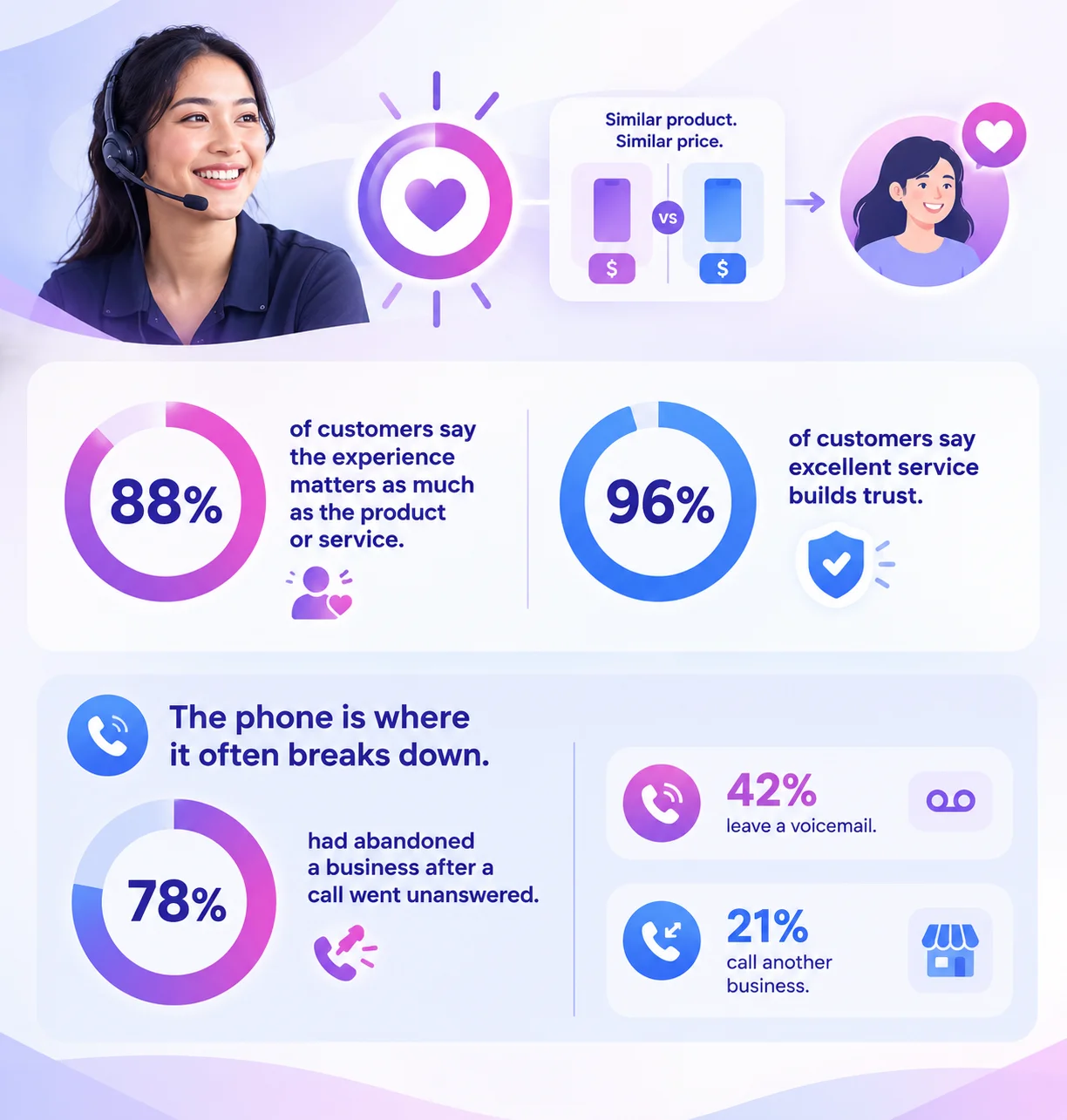
Customer focus decides who gets the job when your product and price look similar to a competitor's. Customers judge you on how dealing with you feels, and they act on it fast.
According to the Salesforce State of the Connected Customer report (fifth edition, 2022), 88% of customers say the experience a company provides matters as much as its products or services. The same report found 96% of customers say excellent service builds trust.
The phone is where this often breaks down. In a 2025 CallRail survey of 1,000 US consumers, 78% said they had abandoned a business after a call went unanswered. Only 42% said they leave a voicemail, and 21% immediately call another business.
For a small business, being customer-focused pays off in four practical ways:
- More repeat business. Customers come back to places that made things easy the first time.
- More referrals. People recommend businesses that treat them well, especially in local trades.
- Better reviews. Happy customers tend to describe how quickly and kindly you handled their problem.
- Fewer lost jobs. You win the calls and inquiries that slower competitors miss.
10 steps to become more customer-focused
The fastest way to become customer-focused is to fix how people reach you, then fix what happens once they do. These steps follow that order, and most cost little or nothing.
1. Make yourself easy to reach
List one main phone number, your hours, and a text or email option on your website, Google Business Profile, and invoices. Search your business name once a quarter and correct any listing with old details.
2. Answer the phone, or make sure someone does
Decide who answers during each part of the day and put it on a simple rota. Forward unanswered calls to a second person after four rings, and use an answering service for times when nobody is free.
3. Set response time standards
Agree on targets for each channel, such as three rings for calls, 15 minutes for missed-call callbacks, and four business hours for email. Post them where the team can see them and check them weekly.
4. Plan for after-hours and busy periods
Check your call log to see when calls are missed most, then cover those hours first. Record a voicemail greeting that says when callers will hear back, and keep an on-call number for real emergencies.
5. Ask what customers need before offering solutions
Ask open questions: what's happening, when they need it sorted, and what a good result looks like. Repeat the key point back before quoting so you solve the right problem.
6. Remember customers so they never repeat themselves
After every call, log the customer's name, what they needed, and what you promised in one shared place. Check those notes before calling back, so the customer picks up where they left off.
7. Let staff fix problems on the spot
Write a short list of fixes anyone can approve, such as a free reschedule or a credit up to $50. Customers get an answer in the first conversation, and staff stop waiting on a manager.
8. Set clear expectations and keep customers updated
Tell customers what happens next, when it will happen, and who will contact them. If a time slips, call them before the original deadline passes.
9. Follow up and ask for feedback
Two to three days after the job, call or text to check everything is working. Ask how easy you were to deal with and what you could improve, then tell customers about any change you make.
10. Review and adjust every month
Spend 15 minutes each month on missed calls, response times, complaints, and reviews. Pick one problem to fix next month and name the person responsible for it.
Customer-focused vs customer-centric vs customer-oriented: what each looks like on a call
These three terms are often used as synonyms. The easiest way to see the difference is to follow one incoming call to your business.
Customer-focused
Customer-focused describes the daily actions that put a customer's needs first. On a call, it means every call gets answered and missed callers hear back within minutes.
Customer-centric
Customer-centric describes a business-wide plan built around customers. On a call, it shows in hours, booking, and follow-up that match when customers actually call.
Customer-oriented
Customer-oriented describes a personal attitude toward serving people. On a call, it's the person on the line who listens, stays patient, and owns the follow-up.
For most small businesses, the result is what counts. A customer who calls at 7 p.m. and ends up with a clear answer and a booked appointment will see you as customer-focused.
Customer-focused phrases and phone scripts
Small wording changes make customers feel helped instead of handled. The rewrites below keep the same facts but point toward what the customer can do next.
Script: Answering a new call
"Thanks for calling Riverside Plumbing, this is Jo. How can I help?"
After they explain: "Got it, so your kitchen sink is backing up and you'd like someone out today. Can I grab your name and address?"
Close with: "You're booked for 2 to 4 p.m. today. You'll get a text when the plumber is on the way. Anything else I can help with?"
Script: When you can't solve it right now
"I want to get this right, so I'm going to check with our technician. I'll call you back by 11 a.m. with an answer. Does that work?"
Script: Returning a missed call
"Hi, this is Jo from Riverside Plumbing. Sorry we missed your call a few minutes ago. How can I help?"
Keep it short and skip the excuses. The customer cares more about getting help now than about why you missed them.
Examples of customer-focused small businesses
Customer-focused small businesses usually win on speed, memory, and follow-through. The scenarios below show what that looks like in four common industries.
Customer-focused small businesses usually win on speed, memory, and follow-through. The scenarios below show what that looks like in four common industries.
Dental clinic: the reminder that saves a morning
A dental clinic started texting patients the day before each appointment with a one-tap reschedule link. Patients who can't make it now rebook instead of simply not showing up.
Law firm: the 15-minute callback rule
A small family law firm set a rule that every new inquiry gets a callback within 15 minutes during office hours. Prospective clients often call several firms, so speed matters.
Using AI without losing the human touch
AI helps customer focus when it gets customers answers faster, and it hurts when it blocks them from a person. The goal is to use AI for the quick, repeatable parts and keep people for the moments that need judgment.
What AI handles well:
- Answering calls instantly, day or night
- Common questions like hours, prices, and service areas
- Booking, rescheduling, and confirming appointments
- Taking messages and sending call summaries
- Capturing new leads after hours
What a person should handle:
- Complaints and upset customers
- Emergencies and safety issues
- Sensitive topics like health, money, or legal matters
- Complex quotes and negotiations
- Anything the caller asks a human to handle
Simple rules for using AI with customers
- Always offer a way to reach a person. Never trap a caller in a loop.
- Be upfront. Let callers know they're speaking with an AI assistant.
- Keep answers current. Update your hours, prices, and FAQs whenever they change.
- Pass urgent calls on fast. Set clear rules for what gets escalated and to whom.
- Review calls regularly. Read summaries weekly to spot questions the AI struggles with.
AI Answering is built for this split. It answers every call, handles routine questions and bookings, and sends you a summary so your team can follow up on anything that needs a personal touch.
Common mistakes to avoid
Most customer focus mistakes come from good intentions applied without limits. Watch for these:
- Treating "the customer is always right" as policy. Customer focus means solving real problems fairly. It doesn't mean agreeing to every demand.
- Collecting feedback and ignoring it. Surveys with no follow-up teach customers that their opinion doesn't matter.
- Being fast but wrong. A quick answer that turns out to be incorrect does more damage than a short wait for the right one.
- Making customers repeat their story. Every handoff without notes forces the customer to start over.
- Hiding your phone number to cut call volume. It reduces calls, and it also pushes frustrated customers toward competitors.
- Relying on voicemail as your backup. Many callers hang up instead of leaving a message.
- Promising what you can't deliver. An honest "Thursday" beats a broken "tomorrow."
How to measure customer focus
You can measure customer focus with a few numbers you probably already have in your phone log, booking tool, or review profiles. Track them monthly in a simple spreadsheet.
The targets are starting points. Compare against your own last month first, since steady improvement matters more than hitting a benchmark.
Final thoughts
Customer focus is built from small habits repeated every day. Answer quickly, listen fully, remember what customers told you, and do what you promised.
Start with the step that fixes your biggest gap. For many small businesses, that's the phone, because a missed call often means a customer who calls someone else.
Never miss another customer call
AI Answering picks up every call 24/7, answers common questions, books appointments, and sends you a summary of each conversation. Your customers get help right away, and your team gets time back for the work that needs them.