

Customers are not rejecting AI answering. They are rejecting AI that blocks the way to a person. In a Gartner survey of 3,566 B2B and B2C customers conducted in February and March 2026, 87% said it is essential that companies offer a way to reach a human agent when they use generative AI. In the same survey, 50% said their interactions are easier when companies use GenAI.
That pairing matters for any business that answers calls with an AI voice agent. The question that decides whether a caller stays is no longer "is this AI good?" It is "can I reach a person if it isn't?"
This article brings together the newest verified data from Gartner, Clio and Pew Research Center, plus what the EU, Utah, Maine and the FCC now require, to show why an AI-plus-human model is becoming the practical standard for answering calls. Every figure links to the page it came from, and a table at the end lists the limits of each source.
The numbers at a glance
Eight verified figures frame the argument, and each one links to the page it came from.
What customers actually want from AI: speed, action, and an exit
AI use is already mainstream. In a Pew Research Center survey of 5,119 U.S. adults fielded February 17 to 23, 2026, 49% said they have used AI chatbots such as ChatGPT, Gemini or Copilot, and 24% use them daily. Pew notes that its 2024 figure (33%) came from a differently worded question, so the two years are not a strict like-for-like comparison.
Customers use AI and ask for a human in the same breath. Gartner's analyst, Eric Keller, says in the August 4 release that service leaders "should not use GenAI as a mandatory first step for every issue." When customers are forced through several unsuccessful AI interactions before reaching a person, the release says they are less likely to use that tool again.
Three other findings from Gartner's customer research shape how an AI answering service should be built:
- Customers want AI to do things, not just talk. Among customers who use GenAI, 58% have used it to complete a task on their behalf, rising to 74% in B2B settings. Gartner's July 8 release quotes Keller saying many company chatbots are still built mainly to answer questions, while customers expect AI to "take action," such as booking an appointment or submitting documents.
- Many company-built bots are being bypassed. The same July release reports customers are about three times more likely to use third-party GenAI tools than company-provided chatbots. It says third-party use has nearly doubled in the past year, while use of company chatbots has remained statistically unchanged since 2022.
- A human option is what wins over skeptics. When Gartner asked customers unwilling to use AI what might change their minds, the most common answer was the ability to switch to a human agent if needed.
For a business that answers the phone, the lesson is practical. A voice agent that books the appointment, captures the details and hands off cleanly to a person when the caller asks meets all three expectations.
Replacing people outright is not paying off
Pressure to adopt AI is high. A Gartner survey of 321 service and support leaders conducted in October 2025 found 91% reported pressure from executive leadership to implement AI in 2026. Spending is following: a separate Gartner survey of 199 leaders, conducted in April and May 2026, found AI spending up 38% while overall service and support budgets grew just 2%.
The returns are less clear. Gartner's July 8 release reports that service leaders put a median 12% of their 2025 budget into AI, the highest of the 10 business functions assessed, yet only 24% have demonstrated positive financial returns across their AI use cases.
Headcount tells a similar story. According to Gartner's February 2026 release, only 20% of customer service leaders have actually reduced agent staffing because of AI. Gartner predicts that by 2027, 50% of companies that attributed headcount reductions to AI will rehire staff to perform similar functions, under different job titles. Gartner's Emily Potosky put it plainly: "AI simply isn't mature enough to fully replace the expertise, empathy, and judgment that human agents provide."
Most leaders are planning for a blend. In the February 18 release, nearly 80% of organizations planned to move at least some agents into new roles, and 84% planned to add new skills to the agent role.
Intentions and results do not match, and Gartner's own pages show the gap. A December 2025 Gartner Q&A on a survey of 321 service leaders (September to October 2025) reported that over 80% of organizations expected to reduce agent headcount within 18 months, mainly through attrition, hiring pauses or layoffs. By February 2026, Gartner reported that only 20% of leaders had actually reduced agent staffing because of AI.
The rules are catching up: say it is AI, and consent before you call
Customer expectations are now being written into law. The picture differs by jurisdiction, so the table lists what each source actually requires.
Two points of care. First, the Commission's FAQ lists "chatbots, AI agents, and avatars" as covered by Article 50(1) and does not mention phone calls specifically; in our reading, an AI agent that answers a call falls within its four criteria, but businesses should confirm with counsel. Second, the FCC ruling is about consent for outbound calls, so it matters most to firms using AI for follow-up and outreach, not to inbound answering.
What people say about being told
Independent surveys point the same way on transparency, though none of them asks about phone answering directly.
- KPMG: In a global study of more than 48,000 people in 47 countries (data collected November 2024 to mid-January 2025), only 46% were willing to trust AI systems, 70% said AI regulation is needed, and four in five said they would be more willing to trust an AI system when assurance mechanisms are in place.
- Gartner: In a survey of 335 U.S. consumers (October to November 2025), 78% said explicit labeling of AI-generated content is "very important" or "the most important factor" in maintaining trust. The question is about labeling AI-generated content, not phone calls.
- Pew: In a survey of 3,488 U.S. adults fielded June 22 to 28, 2026, 72% said it is extremely or very important that a healthcare provider tells them if they use AI in their care.
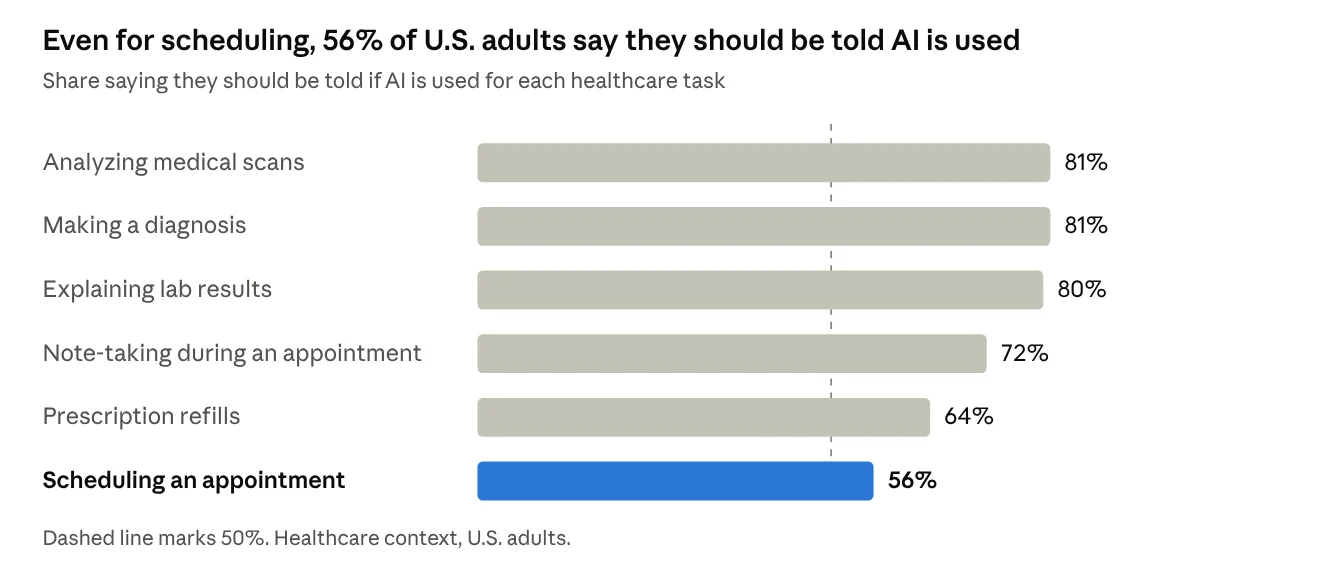
Scheduling draws the lowest share of the tasks charted, yet it is still a majority. The survey is about healthcare, not phone answering, but scheduling is a job many AI receptionists do.
This article is general information, not legal advice.
What a well-designed AI-plus-human answering model looks like
The stakes of a missed or mishandled call are visible in independent data. In Clio's 2024 Legal Trends Report, a third-party research company contacted 500 law firms by email and phone with a client inquiry. Only 40% picked up when called, and 48% were unreachable by phone even after being given the chance to respond to messages. Of the shoppers, 73% said they would not recommend the firm they spoke to. The study covers law firms, but it shows how often a first call goes unanswered or poorly handled.
The Gartner and legal evidence above points to five design principles. These are our recommendations, drawn from that evidence rather than findings of any one study.
- Disclose early and plainly. Telling callers up front that they are speaking with an AI assistant satisfies the direction of the EU, Utah and Maine rules and avoids the trust damage of a caller feeling misled.
- Make the human path obvious. Gartner's 87% figure and its finding that a human fallback is what persuades skeptics make a clear "let me get you a person" route a core feature, not a footnote.
- Let the AI act. Booking, intake and routing meet the "take action" expectation Gartner describes. Answering questions alone does not.
- Escalate on confidence, not on every call. Gartner's Keller says GenAI works best when it collects information, understands intent and attempts resolution only when confidence is high, with a clear path to human support.
- Keep a record. Transcripts, recordings and summaries let a human pick up where the AI left off and help a business show it disclosed AI use.
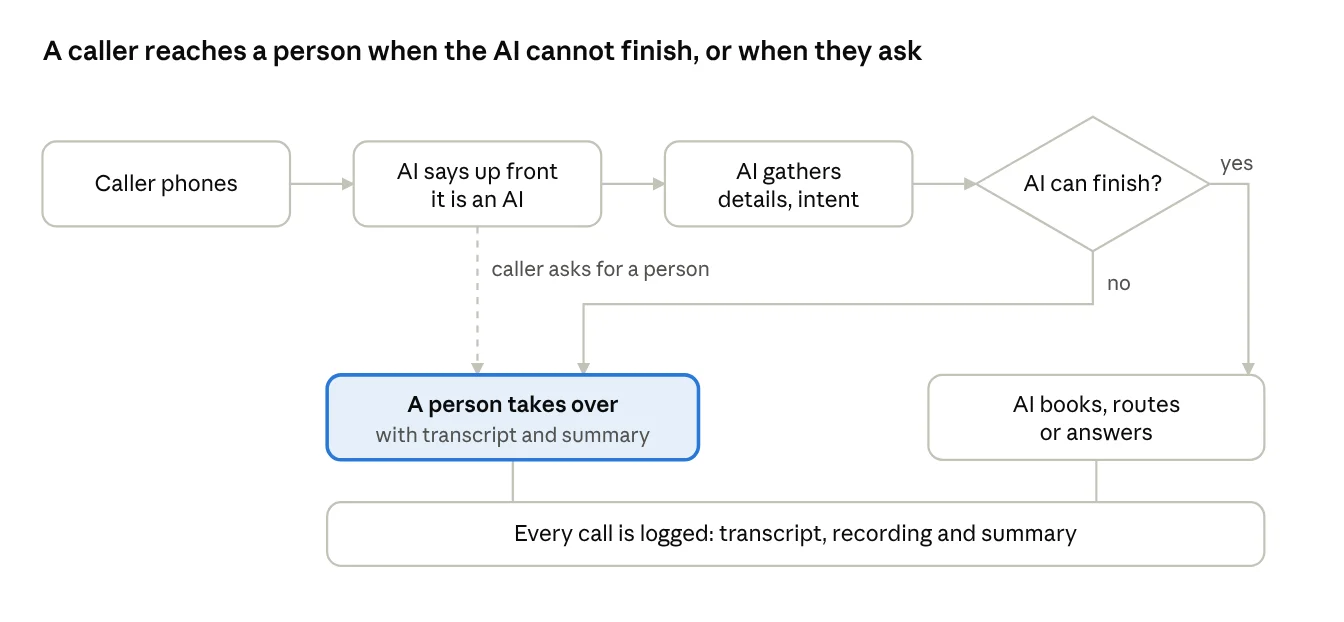
The dashed route is the human escape hatch: a caller who asks for a person skips ahead, and one the AI cannot finish with confidence gets the same handoff. Either way, every call leaves a record.
This is the model Aianswering.ai describes for its own service: AI voice agents backed by live human support, with escalation and call logs that include transcripts, recordings and AI summaries.
A checklist for evaluating an AI answering service
Use these questions when comparing providers. They follow from the evidence and rules above.
- Does the AI tell callers it is an AI, and can you configure the wording and timing?
- Can a caller reach a live person on request, and how fast?
- Can the AI complete tasks such as booking or intake, or does it only take messages?
- Are call recordings, transcripts and summaries available, and who can access them?
- If you call people back or run outbound follow-up, how does the provider handle consent under the TCPA?
- If you handle health, legal or financial information, what written commitments (for example a business associate agreement) does the provider offer? Ask for documents, not marketing claims.
- Do you serve callers in the EU? If so, ask how the provider meets Article 50 disclosure.
- Can the provider show results with a measure you care about, such as answered-call rate, bookings or escalation rate, rather than only call volume?
Frequently Asked Questions
Conclusion
The data points in one direction. Customers are open to AI that gets things done, they want a person within reach, and regulators in the EU, Utah and Maine are moving toward telling people when they are talking to a machine. The businesses best placed for this are not the ones that remove people from the phone line, but the ones that use AI to answer every call and give callers a clear route to a human when it matters.