

Most customers hate calling support because it usually means sitting on hold, navigating rigid keypad menus, and repeating account details to multiple representatives. These delays waste time and create immediate frustration before a customer even speaks with someone who can help.
The Salesforce State of Service Report 2024 states that 77% of service agents say customers are more demanding than they used to be, while wait times remain the top driver of negative reviews. When call volumes spike, human teams get overwhelmed, handle times climb, and customer satisfaction drops.
AI customer service solves this breakdown by answering calls on the first ring, resolving repetitive requests automatically, and routing complex problems directly to the right agent. In this guide, we will look at the research linking speed and resolution to CSAT, the practical ways AI voice agents improve the caller experience, an honest look at the pros and cons, and how platforms like aianswering.ai handle real inbound calls.
The direct link between call center speed and CSAT
Customer satisfaction in a call center is not a mystery. Decades of benchmarking point to the same two drivers: how quickly a caller reaches help, and whether the issue gets resolved without a second call. Everything else, from tone to scripting, sits on top of those two foundations.
Customers expect an answer right away
Patience on the phone has worn thin. Salesforce research found that 83% of customers expect to interact with someone immediately when they contact a company, and the same share expect to resolve complex problems through a single person. The same research found that 48% of customers have switched brands for better service.
Hold time is where that expectation breaks. Every minute in a queue tells the caller their time matters less than the company's staffing budget. Many callers hang up and never call back, which means the business loses not just satisfaction points but the customer entirely.
First call resolution is the strongest lever
Speed gets the caller in the door. Resolution decides how they leave. SQM Group, which benchmarks more than 500 contact centers, has found that every 1% improvement in first call resolution (FCR) produces a 1% improvement in call center CSAT. Each callback a customer must make drops top-box satisfaction by about 15%.
The gap between a resolved and an unresolved call is dramatic:
The same SQM data shows the average contact center resolves only about 70% of calls on the first attempt, so nearly a third of customers have to call back. Only 1% of customers say they want to stop doing business with a company after a first-call resolution, versus 22% when the call goes unresolved.
Why speed and resolution are connected
These two metrics feed each other. Long queues push agents to rush, which lowers resolution. Low resolution creates repeat calls, which lengthens the queue. Traditional call centers try to break the cycle by hiring, but hiring is slow, expensive, and hard to scale for unpredictable spikes.
An AI call center breaks the cycle differently. It removes the queue entirely and gives every caller the same complete, consistent answer, which is exactly the combination the research says customers reward.
Practical ways AI call centers improve customer service
The value of AI customer service on the phone is not abstract. It shows up in specific moments of the call that used to frustrate people. Here are the seven that matter most.
1. Zero hold times, even during spikes
A human team can only take as many calls as it has agents on shift. An AI voice agent can run many conversations in parallel, so the tenth caller during a rush hears the same instant greeting as the first. For a dental office after a holiday weekend or an HVAC company during a heat wave, this alone removes the biggest source of complaints.
2. True 24/7 coverage
Customers do not stop needing help at 5 p.m. A burst pipe at 2 a.m. or a patient with a question on Sunday is exactly when a voicemail box does the most damage. AI answers every call around the clock, captures the details, and books or escalates on the spot instead of leaving the caller to wonder if anyone will call back.
3. Higher first call resolution
Most inbound calls are routine: booking, rescheduling, hours, pricing, directions, order status, or intake. An AI agent trained on the business's own information can complete these end to end. Because it connects directly to the calendar or CRM, it does not need to say "someone will get back to you." The appointment is booked while the caller is still on the line.
4. Consistent answers on every call
Human agents have good days and bad days. One agent quotes the cancellation policy correctly; another forgets a step. An AI agent gives the same accurate, policy-compliant answer every time. That consistency reduces the repeat calls and escalations that drag CSAT down.
5. Smarter routing and warm handoffs
Not every call should stay with AI. A good AI call center identifies the caller's intent in the first few seconds and routes complex, emotional, or high-value calls to a person. The key is the handoff: the human agent receives a summary of who is calling and why, so the customer never has to repeat themselves. Repeating information is one of the most common frustrations callers report.
6. Proactive outbound follow-up
Satisfaction is shaped by what happens after the call too. AI can place reminder calls, confirm appointments, follow up on unpaid invoices, or reconnect with leads who did not book. These small touches reduce no-shows and make the business feel attentive instead of reactive.
7. Data from every conversation
Every AI-handled call produces a transcript, a summary, and structured data. Managers can see why people call, where calls get escalated, and which questions the AI could not answer. That visibility turns customer service into a feedback loop: fix the gaps, update the AI's knowledge, and watch resolution rates climb.
Taken together, these improvements hit both sides of the CSAT equation. Callers reach help faster, and more of them leave with their problem solved.
Traditional call centers vs AI-powered call centers like aianswering.ai
The difference between the two models is less about technology and more about constraints. A traditional call center is limited by how many trained people are available at a given moment. An AI-powered call center is limited mainly by how well it has been configured.
The last row is the important one. The best AI call centers do not try to replace people on every call. They take over the high-volume, repetitive work so human agents can spend their time on the calls that actually need judgment and empathy. aianswering.ai offers this as an "AI + Human" model, where routine calls stay fully automated and live agents step in under rules the business sets.
For most small and mid-sized businesses, the practical question is not "AI or humans?" It is "which calls should humans be spending their time on?"
Pros and cons of AI customer service on voice channels
AI on the phone is powerful, but it is not magic. Understanding both sides helps you deploy it where it improves satisfaction and avoids the situations where it can hurt.
Pros
- No waiting. Every caller is greeted instantly, which removes the single biggest driver of phone frustration.
- Always on. Nights, weekends, and holidays are covered without overtime or an outsourced answering service.
- Handles spikes gracefully. Seasonal rushes, marketing campaigns, and emergencies no longer overwhelm the line.
- Consistent quality. The AI follows your scripts, policies, and tone on every call, without fatigue or turnover.
- Lower cost per call. Routine calls are handled for a fraction of the cost of a staffed seat, freeing the budget for skilled human agents.
- Complete records. Transcripts and summaries make quality assurance, compliance, and training far easier.
- Better use of human talent. Staff spend their time on complex cases and relationship building instead of answering "what are your hours?" fifty times a day.
Cons
- Not every caller wants AI. Salesforce cites Statista research showing 86% of consumers consider it important to be able to reach a real person. A clear path to a human is essential.
- Complex or emotional calls need people. Grief, serious complaints, and nuanced negotiations are poor fits for automation.
- Quality depends on setup. An AI agent is only as good as the information, workflows, and escalation rules it is given. Poor configuration leads to wrong answers.
- Accents, noise, and edge cases. Speech recognition has improved a lot, but noisy environments or unusual requests can still trip it up.
- Privacy and compliance. Healthcare, legal, and financial calls involve sensitive data. You need a provider with proper certifications, such as SOC 2 and HIPAA compliance with a signed BAA.
- Transparency expectations. Some callers feel misled if they discover mid-call that they are talking to AI. Letting the AI identify itself is often the safer choice.
How to get the pros without the cons
The businesses that see the biggest CSAT gains follow a simple pattern. They let AI handle the predictable, high-volume calls, set clear rules for escalation, review transcripts regularly, and keep a human one step away. In practice, this hybrid approach delivers the speed of automation with the reassurance of a real person when it counts.
How AI Answering resolves real-world inbound calls
AI Answering is a 24/7 AI call center that combines AI voice agents with live human support. It has handled more than one million calls and is built for professional practices where a missed call means a missed client: healthcare, law firms, home services, and real estate. Here is what an inbound call looks like from start to finish.
The call lifecycle
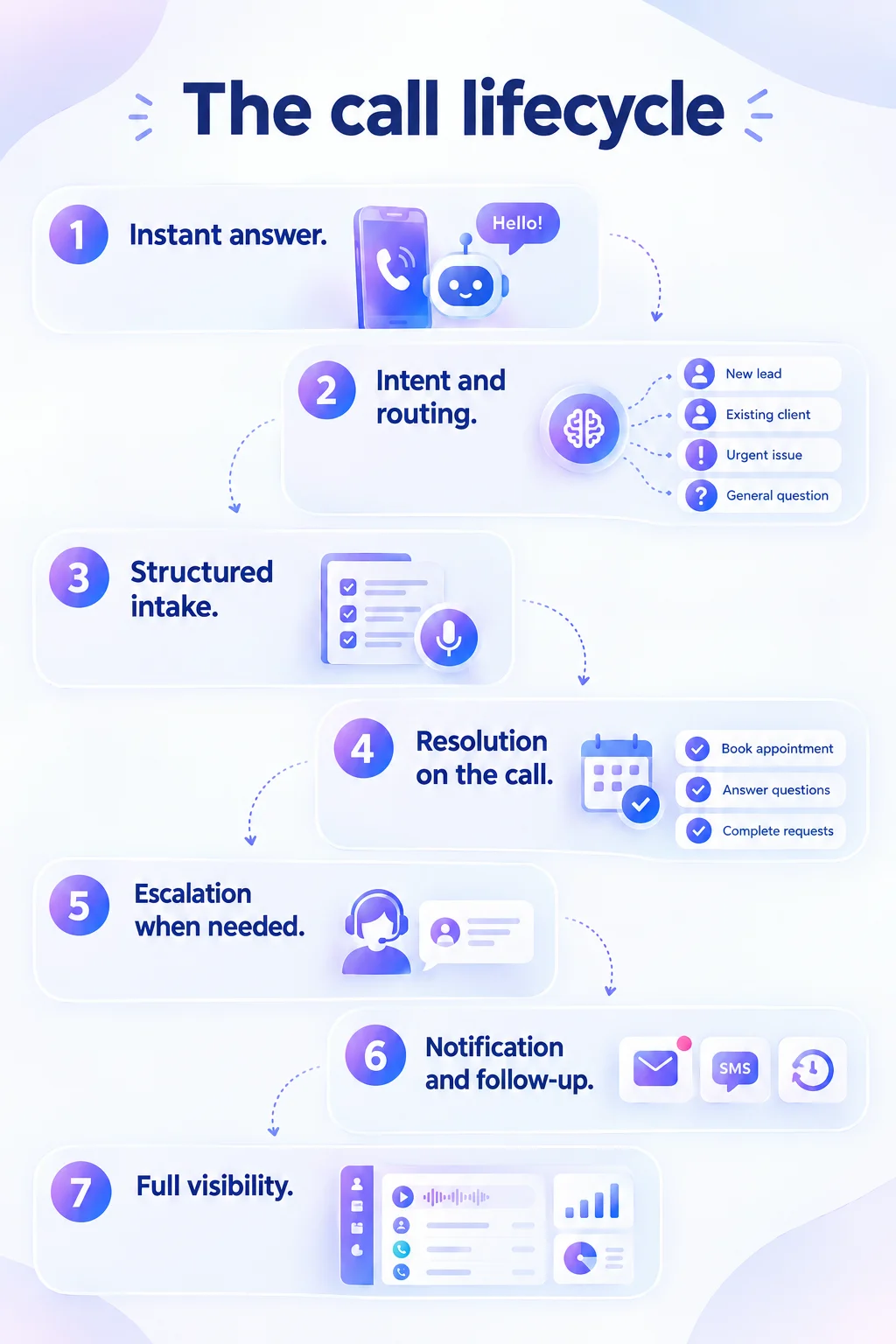
1. Instant answer. The AI picks up on the first ring using the business's own greeting. Businesses can forward or port their existing number, so callers dial the same number they always have.
2. Intent and routing. The AI identifies who is calling and why: a new lead, an existing client, an urgent issue, or a general question. Routing rules can factor in caller type, urgency, and time of day.
3. Structured intake. For new callers, the AI asks the business's own intake questions and captures the answers in an organized record, not a scribbled message.
4. Resolution on the call. Routine requests are completed right away. Appointments are booked directly into Google Calendar, Outlook, or Calendly, and questions are answered from the business's own information.
5. Escalation when needed. If the call meets the conditions the business set, it is handed to a live agent. The agent receives the caller's details, reason for calling, and a summary instantly, so the customer never repeats their story.
6. Notification and follow-up. The team gets real-time SMS or email alerts, contacts update automatically, and outbound calls can handle reminders and follow-ups.
7. Full visibility. Every call is logged with a transcript, recording, and AI summary, and the dashboard tracks volume, escalations, appointments, and handle time.
What this looks like in legal and healthcare industries
Law firms
A potential client calls at 9 p.m. after a car accident. The AI screens for case type and urgency, collects the key details, and books a consultation. aianswering.ai reports that a Los Angeles personal injury firm saw 97% fewer missed intake calls and more consultations booked after going live.
Healthcare
Patients call to book, reschedule, or ask about services. The AI handles scheduling and intake and sends confirmations and reminders, all within a HIPAA-compliant setup with a BAA available.
Built for sensitive industries
AI Answering is SOC 2 Type II certified and HIPAA compliant, with encrypted, access-controlled, auditable call data. Plans start at $997 per month with no per-minute billing, and a one-month free trial lets businesses test the system on real calls before committing.