
Key Takeaways
- A law firm call center is an intake engine and a dedicated team of receptionists or AI agents that answers your phones around the clock.
- Intake agents use firm-approved scripts to collect critical case facts, screen out unqualified leads, and run early conflict checks before attorneys invest billable hours.
- Instead of promising a delayed callback, a legal call center books consultations straight onto the calendar and syncs caller records directly into the firm’s CRM.
Most prospective clients reach out during high-stress situations, and if no one answers immediately, they quickly move on to the next attorney on their list. They will not wait for a callback. This is why modern firms increasingly deploy AI-powered call answering systems to guarantee every lead receives immediate, professional attention without stretching in-house staff thin.
What is a Law Firm Call Center?
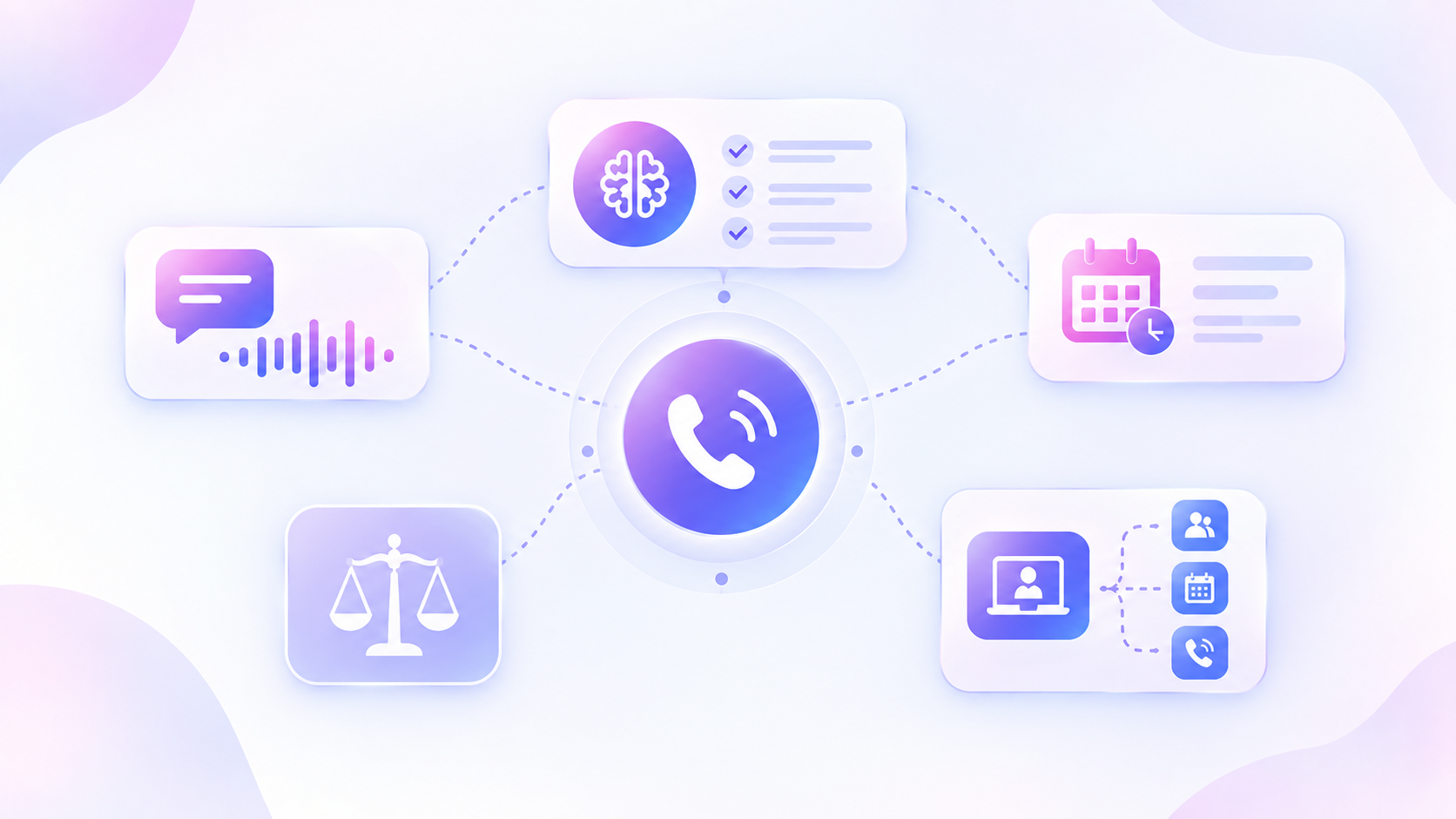
A law firm call center is a team of people, AI, or both that answers your firm's phone calls for you. It uses live legal receptionists or conversational AI agents to ensure someone answers the phone around the clock and enters the case details straight into your software.
Solo attorneys, growing teams,and large litigation practices use these services so they never lose a potential client to voicemail. It gives them a practical way to capture late night calls and protect billable hours during court appearances without having to hire extra in-house staff.
How Does a Law Firm Call Center Work?
A law firm call center answers every inbound call on your behalf, qualifies the caller against your intake criteria, and hands you a booked consultation or a clean message. It works around the clock, follows scripts your firm approves, and logs each conversation straight into your case management system. For most firms, it is the fastest fix for the leak between marketing spend and signed clients.
That leak is bigger than most partners realize. In Clio's 2024 secret-shopper study of 500 law firms, only 40% picked up when a prospective client called, down from 56% in 2019, and 48% were unreachable by phone even after being given the chance to call back (Clio Legal Trends Report). On the calls that were answered, just 41% offered rate information and only 36% explained the process and next steps. Of shoppers who reached a firm, 73% said they were unlikely to recommend it.
What a Missed Call Implies for Law Firms
A missed call is rarely just a missed call; it is usually a lost case, wasted ad spend, and a caller who now hires a competitor. Legal consumers typically call several firms in a row and stop at the first one that answers. Clio found that of the firms that missed a call, only 20% returned it (Oklahoma Bar Journal, citing Clio's 2024 Legal Trends Report).
Lost cases and revenue
The losses add up quickly. A Law Leaders study estimates U.S. law firms miss about 195 million calls a year. At an average 7% conversion rate and $8,000 per client, that works out to roughly $109 billion in potential revenue each year.
Apply those same averages to one firm. A practice that misses 20 new-client calls a month would lose about 1.4 signed cases, or around $11,200 in fees, every month. That is more than $134,000 a year from calls no one picked up.
Wasted marketing spend
Every unanswered call from an ad, a Google listing, or a referral site is money already spent. According to CallRail, the average law firm spends $649 to generate a single lead. Twenty missed paid leads a month means nearly $13,000 in marketing that produced nothing.
Solo and small firms feel it most
Solo attorneys handle calls between court, client meetings, and drafting. LexHelper's analysis found solo attorneys miss more than 35% of calls during business hours and about 90% after hours. More than half of voicemails go unanswered for 72 hours or longer, long after the caller has hired someone else.
Reputation and referrals
Unreachable firms lose future business, not just today's caller. In Clio's study, 73% of secret shoppers would not recommend the firms they contacted. Callers who reached a live person on the phone were the most likely to recommend the firm, at 39%.
Existing client relationships
Missed calls from current clients carry a different risk. ABA Model Rule 1.4 requires lawyers to keep clients reasonably informed and promptly respond to reasonable requests for information. Unreturned calls are also one of the most common sources of client frustration, even when the legal work itself is going well.
A legal intake call center closes that gap with a repeatable process: route the call, screen the lead, check for conflicts, book the consultation, and sync everything to your CRM. Clio found that firms using client-facing technologies earned twice as many leads and twice as much revenue as firms that did not. Below, we break down each step of how a law firm answering service works, compare traditional and AI-powered models, and show the exact questions intake agents ask.
The Technology Architecture Behind AI Answering
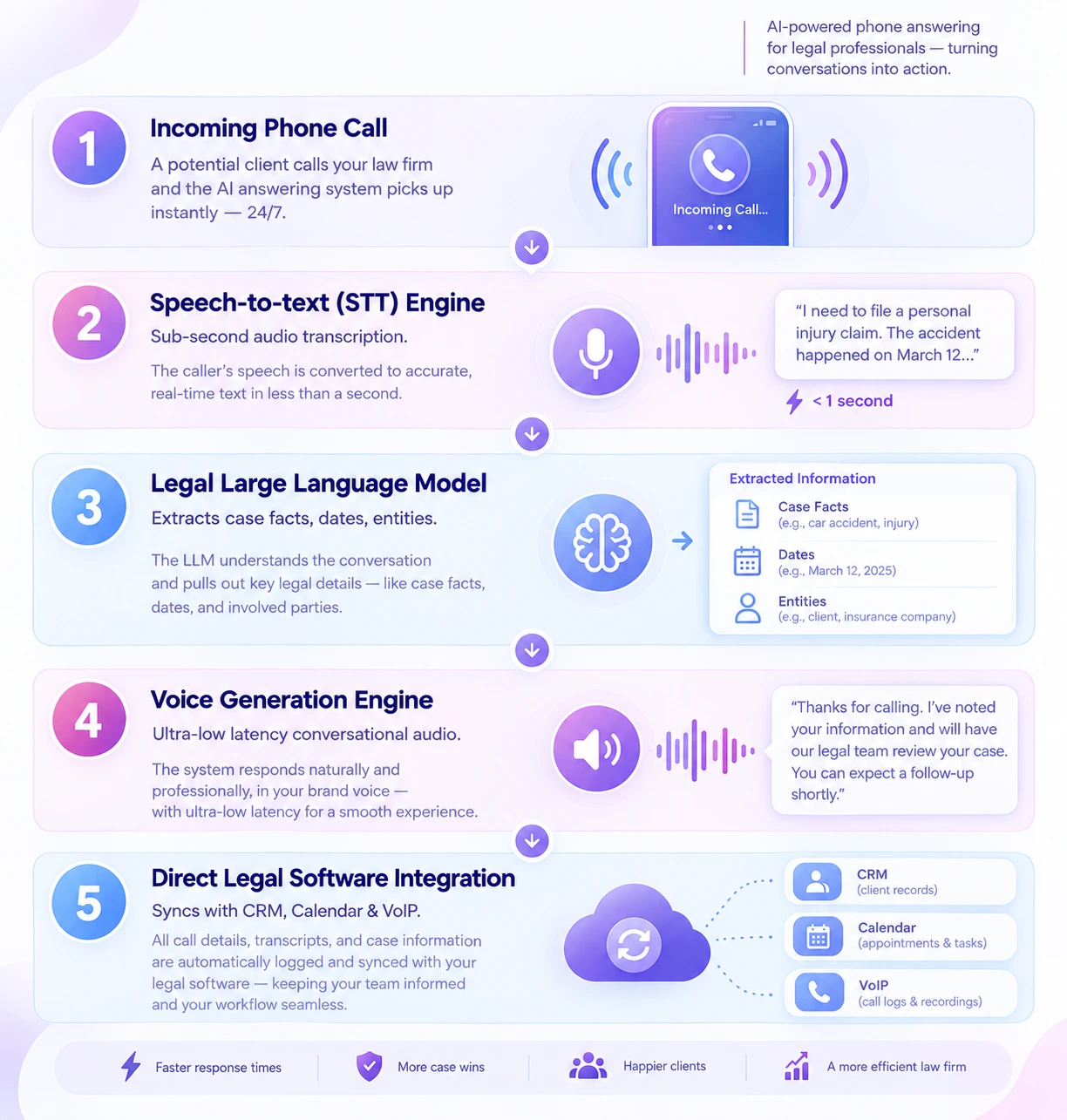
An AI legal center connects several speech and reasoning modules into one live pipeline. When someone calls your office, the system processes their words through four sequential stages in fractions of a second.
The Five-Step Process: From Incoming Ring to a Booked Consultation
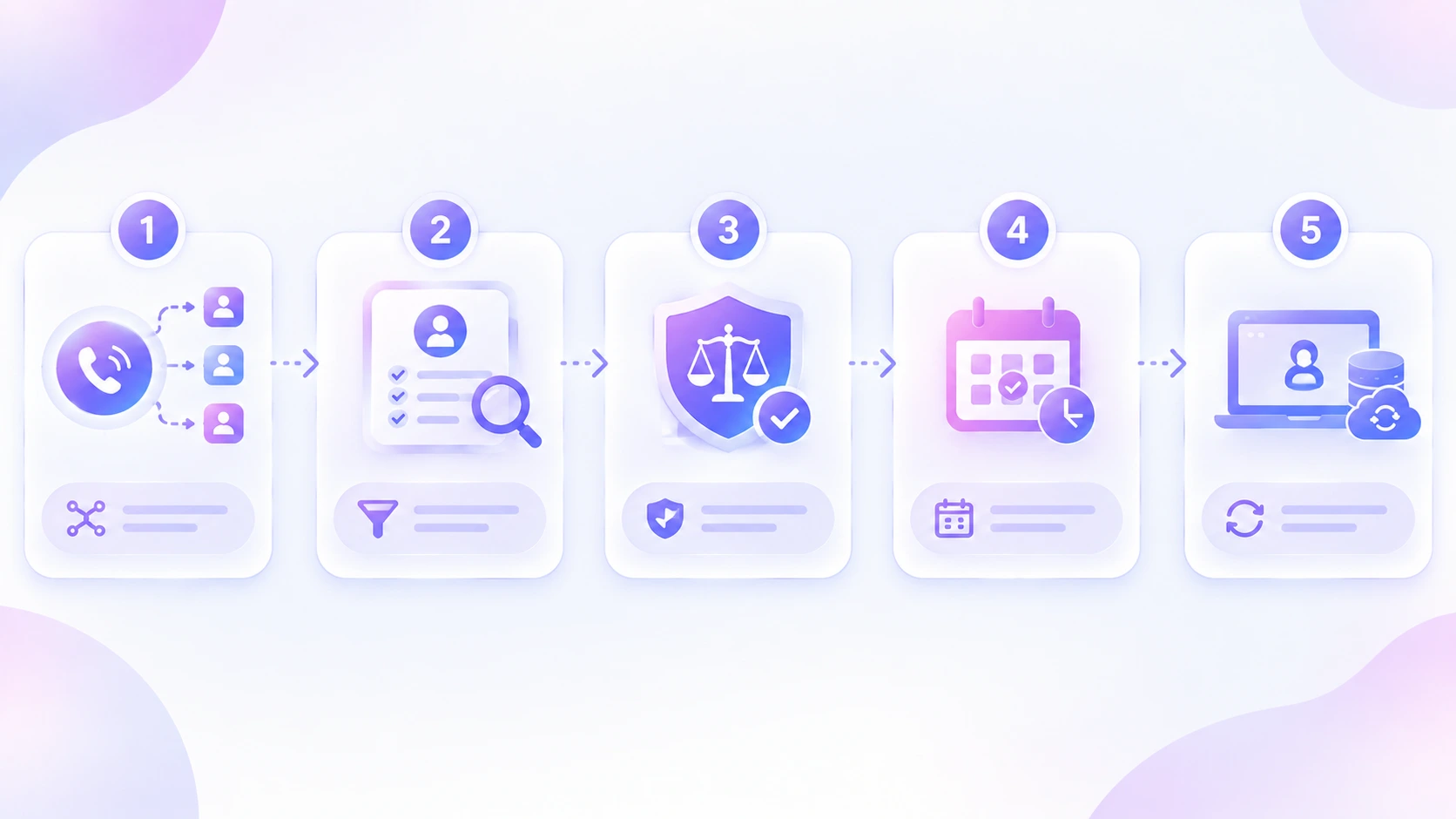
Every law firm call center follows the same five-stage workflow. The details change by practice area, but the order stays the same: route, screen, check, book, sync.
Intelligent call routing
Routing decides who handles a call in the first few seconds. Your firm's number forwards to the call center when you are busy, after hours, or at all times, depending on the plan you choose. The system identifies the call type through the dialed number, an IVR menu, or the agent's opening questions.
From there, calls follow rules you set in advance:
- New potential clients go to intake screening.
- Existing clients get a message taken or a warm transfer to their assigned attorney or paralegal.
- Urgent matters, such as a recent arrest, a court date tomorrow, or a protective order, are escalated to the on-call attorney immediately by live transfer, text, or both.
- Vendors, solicitors, and wrong numbers are filtered out so they never reach your desk.
Multilingual routing matters too. Many services send Spanish-speaking callers straight to a bilingual agent rather than a callback queue.
Tailored lead screening
Screening separates viable cases from calls your firm cannot take. The agent collects the caller's name, contact details, and a short description of the problem, then works through qualifying questions your firm writes. Typical criteria include practice area, jurisdiction, statute of limitations, and whether the caller already has a lawyer.
Qualified leads move on to booking. Unqualified callers receive a polite decline and, if you choose, a referral to another firm or a bar referral service. Either way, the caller leaves with an answer instead of a voicemail.
Immediate conflict checks
A conflict check confirms your firm can ethically take the matter before anyone gives legal advice. The agent captures the names of the prospective client, the opposing party, and any related parties such as an employer, insurer, or co-defendant. The service then searches those names against your client and matter database, or flags them for your team to review.
Running this check at intake stops a common problem: a lawyer hears confidential details from someone the firm cannot represent. That exposure can disqualify the firm from a matter it already handles. Good scripts collect party names first and hold the detailed story until the check clears.
Direct calendar booking
Once a lead clears screening and conflicts, the agent books a consultation directly on the attorney's calendar. Integrations with Google Calendar, Outlook, or your practice management software show real availability, so there is no double-booking and no phone tag. The caller gets a confirmation by text or email, often with a link to an intake form or a payment page for a paid consultation.
Automatic reminders before the appointment cut no-shows. Some firms also let agents send a retainer agreement for e-signature on the same call when the case type is simple.
Instant CRM and case management sync
Every call recording, transcript, and intake questionnaire syncs automatically into your legal software. Platforms like Clio Grow, Lawmatics, MyCase, Filevine, or Salesforce receive the data in seconds. A summary goes to the responsible attorney by email, text, or Slack.
This sync is what turns an answering service into an intake engine. Your team sees which marketing channels bring signed cases, how fast leads get a consultation, and where callers drop off.
Traditional Answering Services vs AI Legal Answering
Traditional services rely on human receptionists working from scripts; AI legal answering uses voice agents that understand natural speech and act inside your software. Many firms now run a hybrid: AI answers every call instantly and hands complex or emotional conversations to a trained human.
The right choice depends on call volume, case value, and how much of intake you want automated. A personal injury firm fielding 300 calls a month from ads gains more from AI speed; a boutique estate planning practice may value a human voice more.
Call Center scripting: What Intake Agents Ask
Intake scripts are written with your firm and follow one rule: gather facts, never give legal advice. Every script opens with the same basics, then branches into practice-specific questions.
Core questions on every call:
- What is your full name and the best number and email to reach you?
- How did you hear about our firm?
- Can you briefly describe what happened or what you need help with?
- Who is the other party involved? (for the conflict check)
- Have you spoken with or hired another attorney about this matter?
- When is a good time for a consultation?
Examples in personal injury
Personal injury scripts focus on liability, damages, and deadlines. The goal is to confirm the case is within the statute of limitations and worth an attorney's time.
- When and where did the accident happen?
- What type of accident was it: car, truck, motorcycle, slip and fall, or workplace?
- Were you injured, and have you received medical treatment? Where?
- Was a police or incident report filed?
- Do you know who was at fault? Was anyone cited?
- Do you have the other driver's insurance information?
- Have you talked to any insurance adjuster or signed anything?
- Are you missing work because of your injuries?
A strong PI script also warns callers not to give recorded statements to the other side's insurer until they speak with an attorney. That is a firm-approved instruction, not advice from the agent.
Examples in criminal defense
Criminal defense calls are time-sensitive and often come from family members. Scripts prioritize custody status and court dates, then escalate fast.
- Are you calling for yourself or for someone else?
- Is the person currently in custody? Which facility?
- What are the charges, if known?
- When was the arrest, and has bail been set?
- Is there an upcoming court date? When and where?
- Has the person spoken to police or made any statements?
- Is there a case or booking number?
Agents are trained to tell callers not to discuss case details on jail phone lines, which are usually recorded. If the person is in custody or has a hearing within 24 to 48 hours, the call goes straight to the on-call attorney.
How to Implement AI Answering in Your Practice
With AI Answering, most firms go live in days, not weeks. The platform is configured around your existing intake process, so the main work is telling it how your firm already handles calls.
- Audit your current calls. Pull 30 days of call logs. Count missed calls, after-hours calls, and how many calls became consultations. This becomes your baseline for measuring results once AI Answering is live.
- Set up your account. In a short onboarding flow, share your call volume, business hours, preferred handling model (full AI or AI + Human), and languages. AI Answering handles English and Spanish callers through the same intake workflow.
- Keep or get your number. Forward or port your existing firm number so callers notice no change, or generate a new dedicated number for a specific campaign or practice area.
- Configure intake by practice area. Each practice area gets its own intake flow and qualification questions, from personal injury and criminal defense to immigration, family law, and workers' compensation. Have an attorney review every script so the AI collects facts and never gives legal advice.
- Set escalation rules. Decide which calls go straight to a person, such as a recent arrest or a hearing tomorrow. AI Answering transfers those calls immediately and passes the full call context to the attorney or live agent.
- Connect your systems. Sync bookings and caller records with Clio, PracticePanther, Google Calendar, Outlook, or Calendly, so consultations land on real availability and no one retypes intake notes.
- Turn on outbound follow-up. Let the AI send appointment reminders, chase incomplete intakes, and request documents such as police reports, medical records, and insurance information through secure SMS or email links.
- Choose your disclosure. You control how the AI introduces itself. Identifying it as an AI assistant at the start of the call builds trust and helps you stay ahead of state bar guidance.
- Test, then launch in stages. Place test calls for each case type, including edge cases like upset callers and existing clients. Start with after-hours and overflow calls, then expand to all calls.
- Review weekly. Use the AI Answering dashboard to track call volume, qualified intakes, booked consultations, show rates, and lead conversion. Read transcripts where callers drop off and refine scripts.
Metrics and ROI: How to Measure Your Call Center's Results
The only way to know whether a law firm answering service pays off is to track a handful of intake metrics before and after launch. Use the 30-day call audit from your implementation as the baseline. Clio's secret-shopper data gives you an industry reference point: only 40% of firms answered a prospective client's call.
Track these weekly for the first three months, then monthly. An AI answering platform such as AI Answering logs call outcomes, transcripts, and lead sources automatically, so most of these numbers come straight from the dashboard and your CRM.
A simple ROI calculation
Start with the revenue from cases you would have missed without the service:
Recovered revenue = additional answered new-client calls × conversion rate × average fee per case
Then compare it to what the service costs:
ROI = (recovered revenue − monthly service cost) ÷ monthly service cost
Your own numbers will differ by practice area. A personal injury firm with higher case values may break even on a single signed case, while a high-volume, lower-fee practice may need several. Plug in your own conversion rate and average fee to see where you land.
How Call Centers Protect Client Confidentiality and Ethics
A legal call center acts as an extension of your firm, so your ethics duties extend to it. Under the ABA Model Rules, lawyers must supervise nonlawyer assistants (Rule 5.3), make reasonable efforts to protect client information (Rule 1.6(c)), and protect information shared by prospective clients even if they never hire the firm (Rule 1.18). ABA Formal Opinion 512 (2024) adds that lawyers using generative AI must understand how the tool handles confidential data.
Reputable legal answering services meet those duties with safeguards like these:
- No legal advice. Agents and AI are scripted to collect facts and never interpret the law or predict outcomes.
- Confidentiality agreements. Staff sign NDAs, and the vendor signs a confidentiality or business associate agreement with your firm.
- Encryption and access controls. Calls, recordings, and records are encrypted in transit and at rest, with role-based access.
- Security certifications. Look for SOC 2 Type II reports and, for firms handling medical records, HIPAA compliance.
- Data retention limits. Recordings and transcripts are kept only as long as your policy allows, and AI vendors should not train models on your client data.
- Call recording consent. Scripts include recording notices that satisfy all-party consent states such as California, Florida, and Pennsylvania.
- Early conflict screening. Party names are captured before case details, limiting exposure to confidential information from adverse parties.
Before signing, ask each vendor for its security documentation, data processing terms, and a sample call recording. Check your state bar's guidance too, since rules on AI disclosure and advertising vary by jurisdiction.
Questions to Ask Before Choosing a Provider
The best way to compare legal answering services is to ask every vendor the same questions and hear a sample call before you sign.
- How do urgent calls reach an attorney after hours?
Good answer: Live transfer or instant text and email, based on rules your firm sets. - What happens when a caller is upset or the matter is complex?
Good answer: A trained live agent takes over with the full call context. - Do you collect party names and run conflict checks?
Good answer: Names captured before case details, checked in real time or flagged for review. - Which CRM and calendar tools do you sync with directly?
Good answer: Native integration with tools like Clio, PracticePanther, Google Calendar, or Outlook. - How do you protect our data, and is it used to train your models?
Good answer: A current SOC 2 Type II report, firm-owned data, and a written no on training. - What does pricing include, and can we try it first?
Good answer: Clear pricing with no surprise overages, a trial on real calls, and no long lock-in.
Ask for a live demo that runs one of your own intake scenarios, such as a car accident call or a family member calling about an arrest. How the system handles that single call tells you more than any feature list. AI Answering, for example, offers a one-month free trial so firms can test it on real calls before committing.
Frequently Asked Questions
Sources:
Answering the call: Why responsiveness is critical for law firm Success: Oklahoma Bar Association (2026) OK BAR Association. Available at: https://www.okbar.org/answering-the-call-why-responsiveness-is-critical-for-law-firm-success-2/
CLIO. Are law firms failing at marketing and client engagement?. https://www.clio.com/guides/client-intake-legal-trends/
Cost of missed calls for solo attorneys (2025) (2025) LexHelper. Available at: https://lexhelper.com/blog/business-tips/cost-of-missed-calls-for-solo-attorneys-2025/