

Call center quality management is the ongoing process of setting service standards, measuring customer interactions against them, and using the results to coach agents and fix broken processes.
Most contact centers already score some calls and coach when they can, but these pieces rarely connect. That is why the same mistakes keep showing up month after month.
This guide shows you how to join them into one program, with a sample scorecard, a seven-step rollout plan, the metrics to track, and how AI is changing quality work.
What is call center quality management?
Call center quality management (QM) is a structured program for defining what good service looks like, checking whether customers actually receive it, and closing the gap when they don't. In a modern contact center, it covers every channel your team handles, including voice, chat, email and messaging, and increasingly the AI agents that resolve contacts on their own.
Every contact center QM program rests on three layers:
- Standards: the behaviors, outcomes and compliance rules that define a good interaction for each type of contact.
- Measurement: monitoring and scoring interactions against those standards, consistently and at a meaningful sample size.
- Improvement: coaching, training and process changes driven by what the measurement reveals.
Quality management is not a vendor invention. The international standard ISO 18295-1 sets service requirements for customer contact centers and applies to in-house and outsourced operations of every size, across inbound and outbound channels. Your contact center does not need certification to benefit, but the standard is a useful reference point when you write your own.
Quality management vs quality assurance vs quality control
These three terms are often used interchangeably, but they do different jobs. Confusing them is one of the main reasons quality programs stall.
In short, QA checks the work, QC finds the systemic causes, and QM connects both to coaching and business decisions. If your contact center stops at QA, you will know which agents scored low but not why the same issue keeps coming back. When hundreds of customers call about the same billing error, that is a process failure that no amount of agent coaching will fix.
Why call center quality management matters
A quality program costs analyst time and supervisor attention, so it needs to earn its keep. Here is where the return comes from.
Higher customer satisfaction
Resolution is the outcome customers notice most. SQM Group research on first call resolution found that every 1% improvement in first call resolution (FCR) brings roughly a 1% improvement in customer satisfaction, and that most customers expect their issue to be solved on the first call. Quality management is how a contact center finds the agent behaviors and process gaps that block first-contact resolution.
Lower operating costs
The same research links each 1% gain in FCR to about a 1% drop in operating costs. Unresolved issues come back to the contact center as repeat calls, transfers and escalations, each one paid for in agent time. Quality control work that explains why customers call back goes straight to the bottom line.
Better agent performance and retention
Agents want to know how they are judged. A consistent scorecard, calibrated feedback and coaching tied to real calls make evaluation feel fair rather than random. That clarity helps new hires reach proficiency faster and gives experienced agents a visible path to improve, which matters in a contact center role known for high turnover.
Safer AI adoption
Contact center leaders are being pushed to deploy AI quickly. In a Gartner survey of 321 service leaders conducted in October 2025, 91% said they faced pressure to implement AI in 2026, with customer satisfaction and operational efficiency among their top priorities. A quality program gives you the standards and evidence to prove AI is helping customers rather than frustrating them.
6 key parts of a contact center quality management program
Whatever your contact center's size, a working QM program needs six components. Missing any one of them usually explains why scores fail to move.
- Written quality standards: a plain-language definition of a good interaction for each contact type, including required compliance steps.
- QA scorecards: weighted evaluation forms that turn those standards into criteria an evaluator can score consistently.
- Monitoring and sampling rules: how interactions are selected for review, how many per agent, and which contact center channels are covered.
- Calibration: regular sessions where evaluators score the same interactions and agree on how criteria are applied.
- A coaching loop: a defined path from every evaluation to a coaching action, with a follow-up check on whether behavior changed.
- Reporting and governance: dashboards and a review cadence that put quality data in front of the contact center leaders who decide on staffing, training and process changes.
How to build a call center quality management program in 7 steps
The steps below work for a 20-seat in-house contact center or a multi-site outsourcer. Each step names an owner and the output you should have before moving on.
Step 1: Define what quality means for your customers
Start from the customer, not the script. Pull your last three months of CSAT comments, complaints and repeat-contact reasons, and list what customers praise and what makes them call your contact center back. Combine that with your brand promise and any regulatory obligations.
Owner: head of quality with operations and compliance. Output: a one-page quality standard per major contact type, written as observable behaviors, such as "confirms the customer's issue in their own words before proposing a fix."
Step 2: Map your contact types and risks
Not every interaction carries the same weight. A password reset and a disputed payment need different checks. Group your contact center's interactions into types, then rate each for volume, customer impact and compliance risk.
Owner: QA lead. Output: a contact-type matrix that tells you where to focus reviews and which types need their own scorecard or extra auto-fail criteria.
Step 3: Build a weighted QA scorecard
Translate your standards into a scorecard with five to seven sections, clear pass criteria and weights that reflect what matters most to customers. Keep criteria objective. "Agent was friendly" invites disagreement; "agent acknowledged the customer's frustration before troubleshooting" does not.
Here is a sample general customer service scorecard for a contact center.
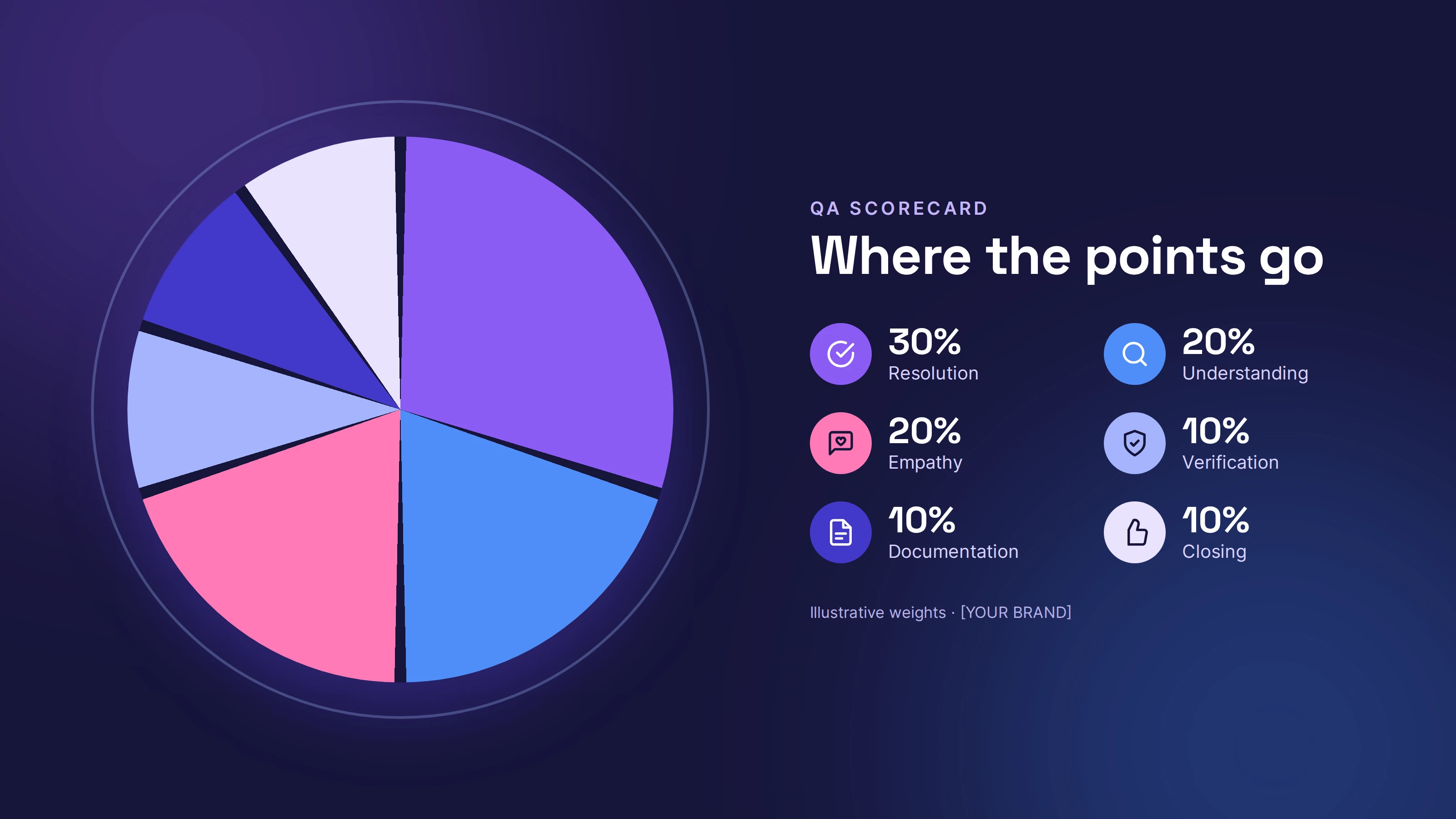
Auto-fail items protect your contact center from risks a weighted average can hide. An agent could score 92% while reading a customer's full card number into a recorded line.
Owner: QA lead with compliance. Output: version-controlled scorecards for each priority contact type.
Step 4: Decide how you will monitor and sample
Reviewing one or two calls per agent each month tells you very little. A single unlucky call can sink a score, and agents quickly learn that the odds of any given call being reviewed are low. If your contact center scores manually, aim for at least four to six evaluations per agent per month, spread across contact types, days and shifts, and add targeted reviews for long calls, transfers and contacts followed by a complaint.
Cover every channel your customers use. A customer who chats on Monday and calls on Tuesday experiences one brand, so chat and email deserve the same standards as voice. If you use automated QA (covered below), you can score close to all interactions and reserve human review for edge cases, appeals and calibration.
Owner: QA lead. Output: a written sampling plan with targets per agent and per channel.
Step 5: Calibrate evaluators before you score at scale
If two evaluators can listen to the same call and land ten points apart, agents will stop trusting the scores, and they will be right to. Calibration fixes this. Each session, every evaluator (and ideally a contact center supervisor or two) independently scores the same three to five interactions, then the group compares results, discusses each disagreement and records how the criterion should be applied.
Run sessions weekly while a new scorecard beds in, then every two to four weeks. A sensible starting target is for each evaluator to land within five percentage points of the agreed score. Track the variance over time; if it widens, a criterion is probably too vague and needs rewriting.
Owner: QA lead. Output: a calibration log with decisions and evaluator variance.
Step 6: Connect every score to coaching
This is where most contact center programs break. Scores land in a spreadsheet, nobody acts on them, and the same gap appears next month. Set a rule that every evaluation below target, and every auto-fail, triggers a coaching action within a set time, such as five working days.
Good coaching sessions are short and specific. Play the moment in the call, agree on one behavior to change, and schedule a follow-up check on the next set of evaluations. Recognize strong calls too. Pointing to a call where an agent handled an angry customer well teaches as much as correcting a weak one.
Owner: team leaders and supervisors. Output: a coaching record linked to each evaluation, with a follow-up result.
Step 7: Review, report and refine
Hold a monthly quality review with operations, training and, where relevant, product teams. Look at QA scores alongside customer outcomes, and at quality control findings: the top reasons for repeat contacts, complaints and escalations. Route process problems to their owners instead of asking agents to absorb them.
Then update the standards. If customers keep raising an issue the scorecard ignores, add it. If a criterion never changes anyone's score, cut it. Quality management is a cycle, and your contact center scorecard should evolve with your customers.
Owner: head of quality. Output: a monthly quality report and a changelog for standards and scorecards.
Contact center quality metrics to track
QA scores tell you whether agents follow your standards. Customer and operational metrics tell you whether those standards produce the outcomes your contact center wants. Track both, at agent, team and contact-type level.
How AI is changing call center quality management
AI has shifted contact center quality management from sampling to near-full coverage, and it has added a new kind of agent to evaluate. Investment is following: a Gartner survey of 199 service leaders found AI spending up 38% while overall service budgets grew just 2% (August 2026).
Scoring 100% of interactions
Automated QA tools transcribe calls and score every contact center interaction against your scorecard, flagging compliance misses and low-scoring contacts for human review. This removes the sampling problem and lets analysts spend their time on calibration, edge cases and coaching insight rather than listening to routine calls. Automated scores still need calibration against human judgment, especially for soft-skill criteria such as empathy.
Real-time guidance
Agent-assist tools can surface knowledge articles, prompt a missing disclosure or suggest next steps during the conversation. Used well, they prevent errors that contact center QA would otherwise catch after the fact. Measure their impact the same way you measure anything else: through QA scores, FCR and CSAT before and after rollout.
Quality assurance for AI agents
If AI agents or chatbots handle contacts, hold them to the same standard as your contact center staff. Score their conversations against the same accuracy, resolution and compliance criteria, and add checks for clean escalation to a human. Customers expect that option: in a Gartner survey of 3,566 customers, 87% said companies using GenAI for service must provide access to a human agent (August 2026). Human expertise is not going away either; Gartner also predicts that half of companies that cut service staff because of AI will rehire by 2027.
Common call center quality management mistakes
Most call center quality management programs fail for the same reason: they measure agents without fixing what the measurement reveals. These six mistakes cause most of the damage in a contact center.
- Treating QA as the whole program. Scoring without root cause analysis and coaching produces data, not improvement.
- Scorecards that are too long or too vague. Forty criteria overwhelm agents; subjective wording guarantees disagreement. Keep it to what matters and make each criterion observable.
- Skipping calibration. Inconsistent scores destroy agent trust faster than any other flaw.
- Tiny samples. One or two reviews per month cannot represent how an agent really performs.
- Averaging away compliance risk. A high overall score should never hide a missed mandatory step. Use auto-fail items and report compliance separately.
- Blaming agents for process failures. If many agents fail the same criterion, the problem is probably training, tools or process, not people.
What to look for in quality management software
Spreadsheets work for a small team, but most contact centers outgrow them once they cover several channels or sites. When you compare call center quality management software, check for:
- Configurable, weighted scorecards with auto-fail criteria and version history
- Coverage of every contact center channel you serve, including AI-agent conversations
- Automated scoring with a clear way to review and override AI scores
- Built-in calibration workflows and evaluator variance reporting
- Coaching workflows linked directly to evaluations
- Integrations with your telephony, CRM and workforce management systems
- Security and compliance controls such as redaction of payment and personal data
Frequently Asked Questions
Start building your quality management program
Call center quality management works when standards, measurement and improvement run as one loop. Start small: define standards for your contact center’s highest-volume contact type, build one weighted scorecard, calibrate your evaluators and link every score to coaching. Then expand. Want help putting this into practice? See how AI Answering's AI call center pairs AI voice agents with live human support, with transcripts and recordings ready for every QA review.