

It's 9 p.m. and your phone rings. A customer's voice is shaking because the technician never showed, and they took an unpaid afternoon off work to wait.
Can AI answering services handle complex or emotional customer complaints like this one? Yes, they can calm and resolve many of them, provided they know exactly when to pass the call to a person.
You've spent years earning these customers, so handing their worst moments to a machine can feel risky. This guide shows which complaints AI can own, which it should start, and which belong with a human.
Why complaints are harder than routine calls
A booking call has one goal, but a complaint has three. The caller wants to be heard, get it fixed and feel respected.
Trust matters too. In a Gartner survey of 5,728 customers, 64% said they would prefer companies not use AI in service, mainly because they fear never reaching a person.
Complexity and emotion are separate dials. A calm customer can have a tangled billing dispute, while a furious one may simply have a missed delivery.
What AI answering services handle well today
Without AI, that 9 p.m. call goes to voicemail, the customer stews all weekend, and a one-star review appears on Sunday. With AI, the call is answered on the first ring, logged, and a callback is booked for Monday at 8 a.m.
The AI stays calm however heated the call gets, captures the full story, and notices when frustration is rising. Callers rarely have to repeat themselves.
For problems you already have a fix for, AI can resolve the call end to end. Rescheduling a missed visit, resending an invoice or booking a priority callback are typical examples.
It never gets defensive
An AI agent does not take a raised voice personally. It does not interrupt, sigh or match the caller's tone.
On the tenth angry call of a bad Monday, it sounds exactly as patient as it did on the first. That consistency is hard for even the best human teams to sustain.
Calm is contagious. When the voice on the line stays steady, most callers settle down within the first minute.
It answers at any hour
Waiting makes upset people angrier. A complaint that lands at 9 p.m. on a Saturday and hits voicemail has a whole weekend to grow.
An AI answering service picks up on the first ring, every time. The caller hears a real response instead of a beep.
It also sets expectations straight away, such as when someone will call back. Knowing what happens next takes much of the heat out of a complaint.
It captures the full story
AI records the caller's account, order or job numbers, dates and the outcome they want. Nothing depends on someone scribbling notes mid-call.
Your team receives a clean, structured summary instead of a vague voicemail. They can act before they even pick up the phone.
This prevents the most common reason complaints escalate: making the customer explain everything twice.
It notices rising frustration
Sentiment analysis reads word choice, repetition and phrases like “this is the third time” or “I want to cancel.”
The AI cannot feel what the caller feels, but it can recognize the pattern reliably. It then slows down, apologizes or offers a person.
Those signals also show up in your call summaries. Over time, they reveal which problems upset customers most..
Where AI still falls short
AI should never grant exceptions, refunds or credits outside your written policy. Those are judWithout AI, that 9 p.m. call goes to voicemail, the customer stews all weekend, and a one-star review appears on Sunday. With AI, the call is answered on the first ring, logged, and a callback is booked for Monday at 8 a.m.gment calls for a person.
Genuine distress, safety issues, legal threats and regulated topics need a trained human immediately.
When a caller asks for a person, the AI must transfer or book a callback at once. Resisting that request is the fastest way to lose a customer.
Exceptions and goodwill gestures
Sometimes the right answer is “normally no, but for you, yes.” That is a judgment call, and it belongs with someone who knows the customer's history.
AI follows the rules you give it. It should never invent refunds, credits or promises to calm a caller down.
Instead, it captures the request and routes it to someone with authority. The customer still gets a fast, clear next step.
Real distress
Some callers are grieving, frightened or describing something that affects their health or safety. They need a human voice, not a process.
AI can detect distress and act on it quickly. Responding with real care and accountability is a human job.
Your AI should hand these calls over at once, or point to emergency services when your policy says so.
Legal and regulatory risk
Threats of legal action, discrimination claims, data breaches and regulated advice all carry consequences a script cannot weigh.
A well-meant but wrong sentence on one of these calls can cost far more than the complaint itself.
Route them to a trained person immediately, and make sure the AI's summary records exactly what the caller said.
Brand-new problems
AI is strongest where your knowledge base is strongest. A failure nobody has seen before leaves it with nothing reliable to draw on.
Complaints that cut across several departments or orders also need human reasoning to untangle.
The good news is that each new problem, once
The complaint triage matrix: who should handle what
Score each complaint on two dials: how complex the fix is and how emotional the caller is. Where it lands tells you who should own it.
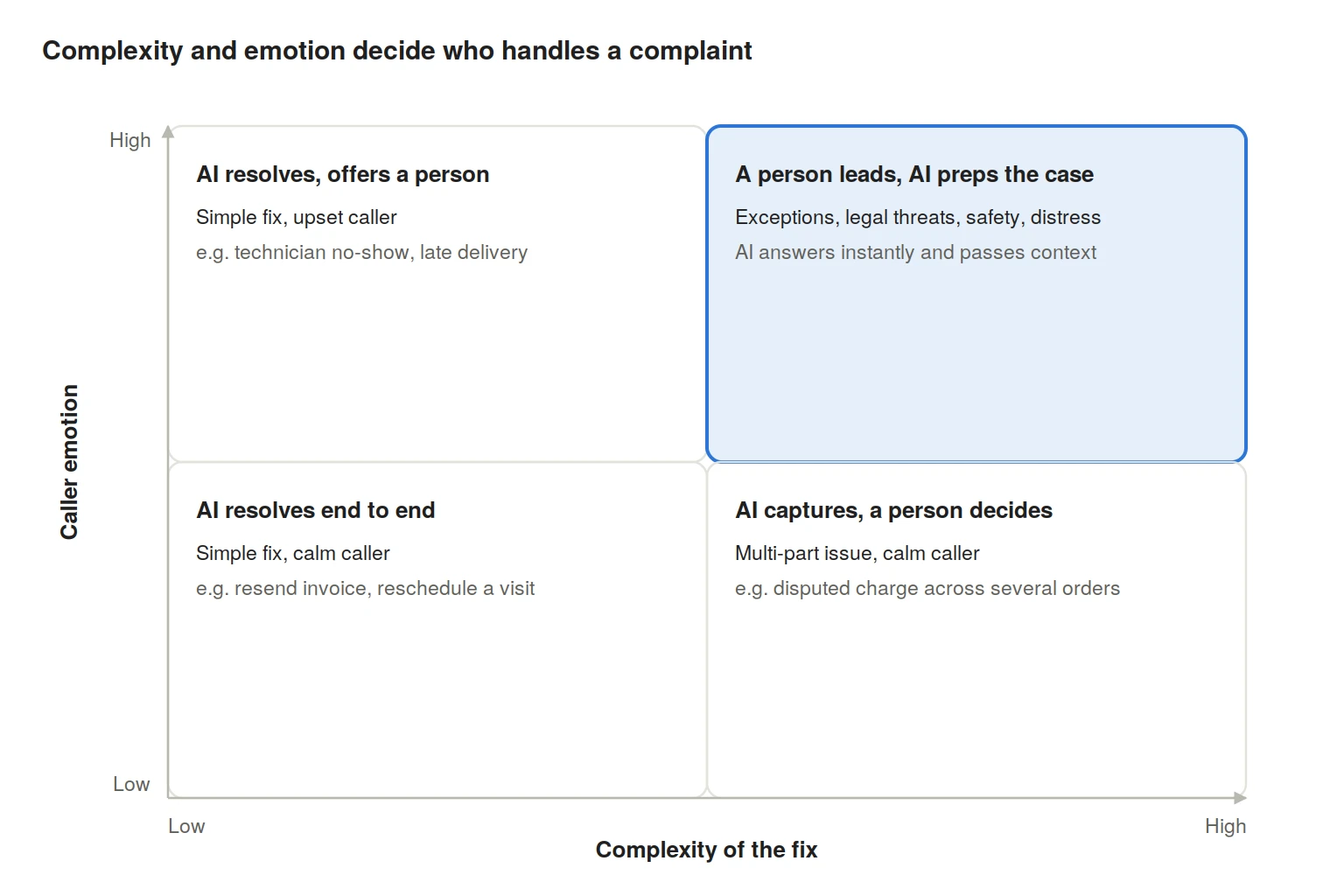
AI fully owns simple, calm complaints and resolves most simple, upset ones while offering a person.
For complex complaints a person decides, while AI answers instantly and hands over the facts. Map your most common complaints onto this grid and it becomes your escalation policy.
What complaint calls look like by industry
Every industry has its own kind of upset caller. Here is how the triage matrix plays out in four common ones.
Home services
Missed appointments, late technicians and repeat repairs drive most complaints. They are often emotional but simple to fix.
AI can apologize, rebook the first available slot and flag it as priority. It can also text the customer a confirmation so they stop worrying.
Damage to a customer's home or a safety concern, like a gas smell, should go straight to a person.
Dental and healthcare practices
Patients call about billing surprises, long waits or a treatment that still hurts. Emotions can run high because health is personal.
AI can handle scheduling changes and explain how billing questions will be followed up. It should never give clinical advice.
Any mention of pain getting worse, a reaction to treatment or an urgent symptom needs a clinician or emergency guidance right away.
Law firms
Clients complain about slow updates, unreturned calls or confusing invoices. Often they are already anxious about their case.
AI can log the concern, confirm the matter details and book a callback with the right attorney or paralegal.
It should never discuss case strategy or legal advice, and any threat to file a complaint against the firm should reach a partner quickly.
Real estate teams
Buyers, sellers and tenants call about missed showings, slow responses or maintenance problems.
AI can reschedule showings, log repair requests and reassure callers about when they will hear back.
Deposit disputes, contract questions and anything that sounds like a legal threat should go to an agent or manager.
How a well-built AI answering service handles an angry caller
Picture a homeowner calling at 7:40 p.m. because the plumber never arrived. The AI answers instantly, lets them vent, and reflects back what went wrong with one sincere apology.
Next it checks the booking and offers a real fix: “I can book you the first slot tomorrow at 8 a.m. as a priority, or have the service manager call you tonight. Which would you prefer?”
Finally, it confirms the next step by text and logs a summary for your team. It never promises discounts it cannot give or hides the human option.
Escalation triggers and handoff design
Set escalation triggers in advance: a request for a person, rising negative sentiment, words like cancel or lawyer, any safety issue, or a fix outside policy.
Every handoff should carry a short summary, the customer's details, what the AI already offered and how the caller is feeling.
If nobody is free, book a callback with a specific time window and honor it. A warm callback beats a cold transfer to voicemail every time.
Common mistakes that make complaints worse
The biggest mistake is hiding the human option. It is exactly what makes customers distrust AI service.
Repeating scripted empathy, letting the AI improvise policy and transferring calls without context all make complaints worse.
Assign an owner for every escalation and review complaint transcripts weekly. Always tell callers they are speaking with an AI assistant.
Empathetic phrases that work on complaint calls
The words your AI uses matter as much as the fix it offers. Small changes in phrasing can turn a tense call into a calm one.
The pattern is simple: name the specific problem, say what you will do, and say when. Specifics sound human, while stock phrases sound like a script.
One sincere apology is enough. After that, every sentence should move the caller closer to a fix.
How AI Answering approaches complaint calls
AI Answering's voice agents answer 24/7 with natural speech, so complaints are captured while they are still small.
During onboarding we map what the AI can resolve and what it must escalate. You choose the triggers, the people and the backup plan.
Picture a family-run HVAC company: its AI takes a furious late-night call about a broken furnace, flags it urgent and texts the owner a summary, including how upset the caller sounded. The customer gets a callback within the hour instead of a voicemail beep, and can ask for a person at any point.
Frequently Asked Questions
The bottom line
AI answering services can handle complex or emotional complaints well, as long as they know their limits. Handled with care, a complaint often turns an upset caller into your most loyal customer.
Let AI answer fast, stay calm and fix what policy allows. Let your people handle exceptions and distress, with full context in hand.
Ready to see how AI Answering handles your complaint calls? Book a demo or see pricing to find the right plan.